



AI - Artificial Intelligence, Company Culture, Employee Engagement , Employee Experience, Leadership & Management
Key Takeaways:
- AI in the workplace pays off most when regular use extends past the leadership team, since monthly users are more likely to give extra effort, adapt quickly, and stay.
- AI adoption stalls wherever access does, with 82% of executives reporting helpful AI tools against just 38% of individual contributors.
- Employee resource groups are a ready-made engine for AI momentum, because members are more likely than their colleagues to use AI.
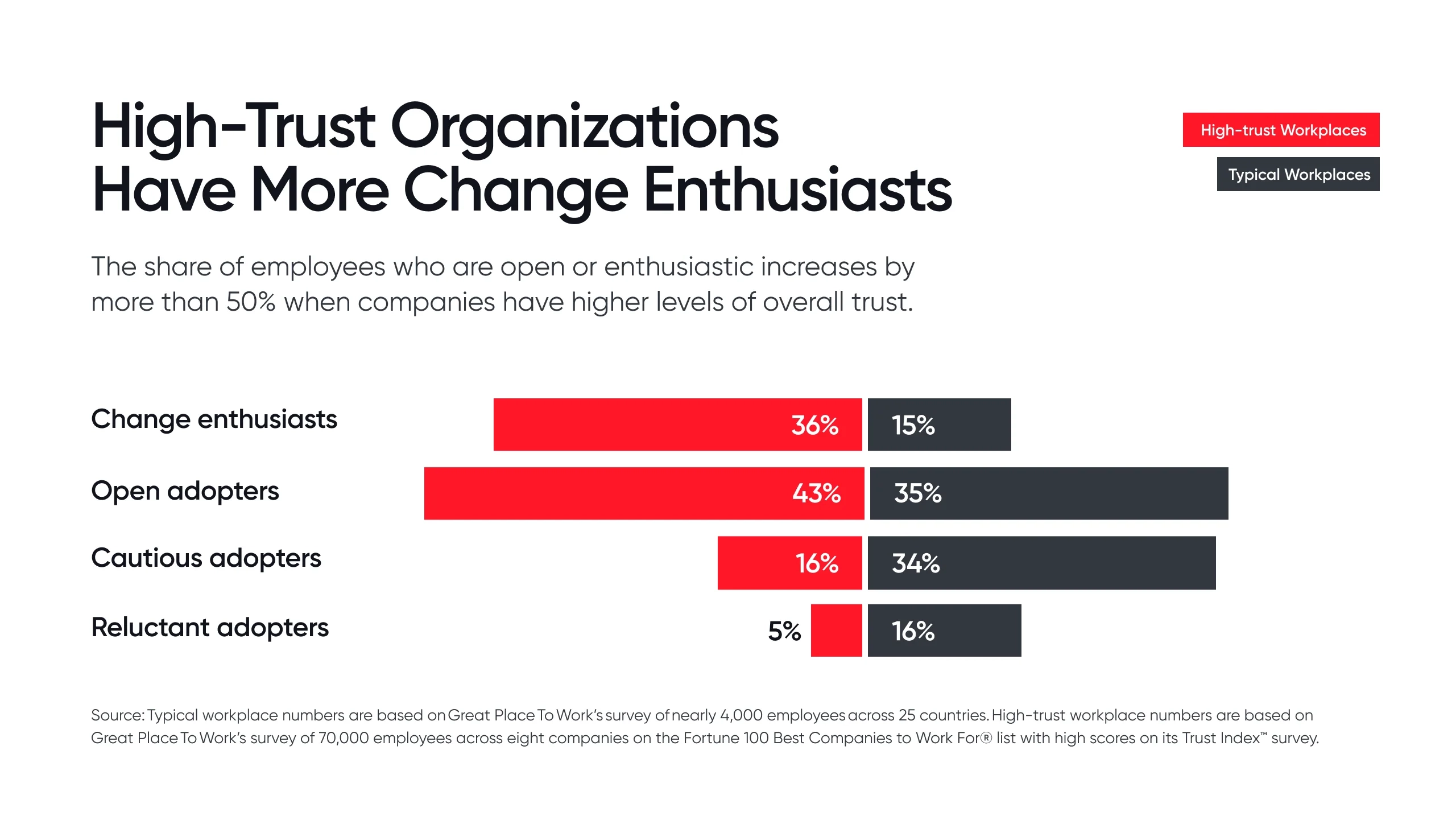
- Organizational change takes hold faster in high-trust workplaces, where 36% of employees are change enthusiasts compared with 15% elsewhere.
- AI strategy gains traction through encouragement, as employees who feel their leaders support AI use are 2.5 times more likely to use it monthly.
- Workplace culture is the multiplier, with the highest-trust organizations outperforming the market by 3.5 times over 27 years.
What happens to your culture when some employees lean into AI and others never get the chance?
A recent Great Place To Work global survey of close to 4,000 employees in 25 countries offers a clear answer: people who use AI regularly bring more of the behaviours that drive business performance. The findings rest on three decades of Great Place To Work research into the employee experiences that predict how organizations perform.
Canadian employers are moving quickly. According to Statistics Canada, 19.2% of businesses used AI to produce goods or deliver services in the second quarter of 2026, roughly triple the share from two years earlier. The question for leaders is no longer whether AI in the workplace will arrive, but whether it will reach everyone.
What Active AI Users Bring to Workplace Culture

Compared with colleagues who rarely or never use it, employees who turn to AI at least once a month were more likely to:
- Give discretionary effort: going beyond what the role strictly requires
- Adapt quickly: adjusting with less friction when circumstances change
- Stay: intending to build their careers with their current employer
Each of these experiences is part of the Great Place To Work Effect, the measurable link between workplace culture and financial results. Across 28 years, the organizations with the highest levels of employee trust have outperformed the market by three times. Canadian research points in the same direction: in its baseline comparison, a Statistics Canada study found that firms using AI showed labour productivity about 16.8% higher than firms that did not.
Why AI Adoption Stalls Before It Reaches the Frontline
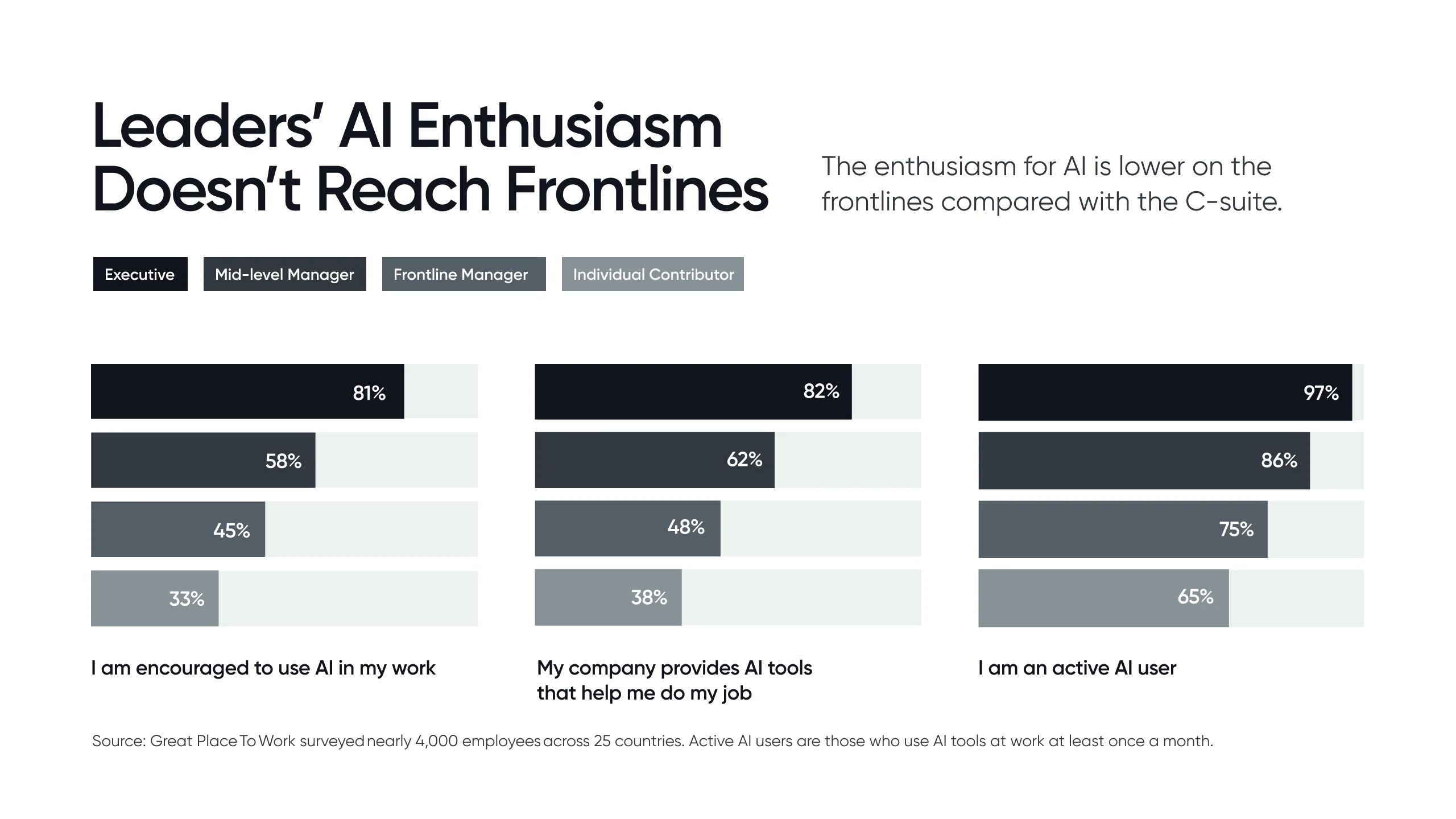
Leaders who are fully committed to AI should read the results carefully. In typical workplaces, excitement about AI at the executive level is not filtering down to the people doing the day-to-day work.
A major reason is access. While 82% of executives say their organization gives them AI tools that help them do their jobs better, that figure falls to 48% among frontline managers and 38% among individual contributors. Usage follows the same curve: 97% of executives use AI at least monthly, compared with 65% of individual contributors.
When the tools stop at the leadership layer, the enthusiasm stops there too, and so do the performance gains.
How Employee Resource Groups Build AI Momentum
One practical starting point already exists in many organizations: employee resource groups (ERGs). In typical workplaces, employees who took part in an ERG were more likely than their non-participating colleagues to use AI.
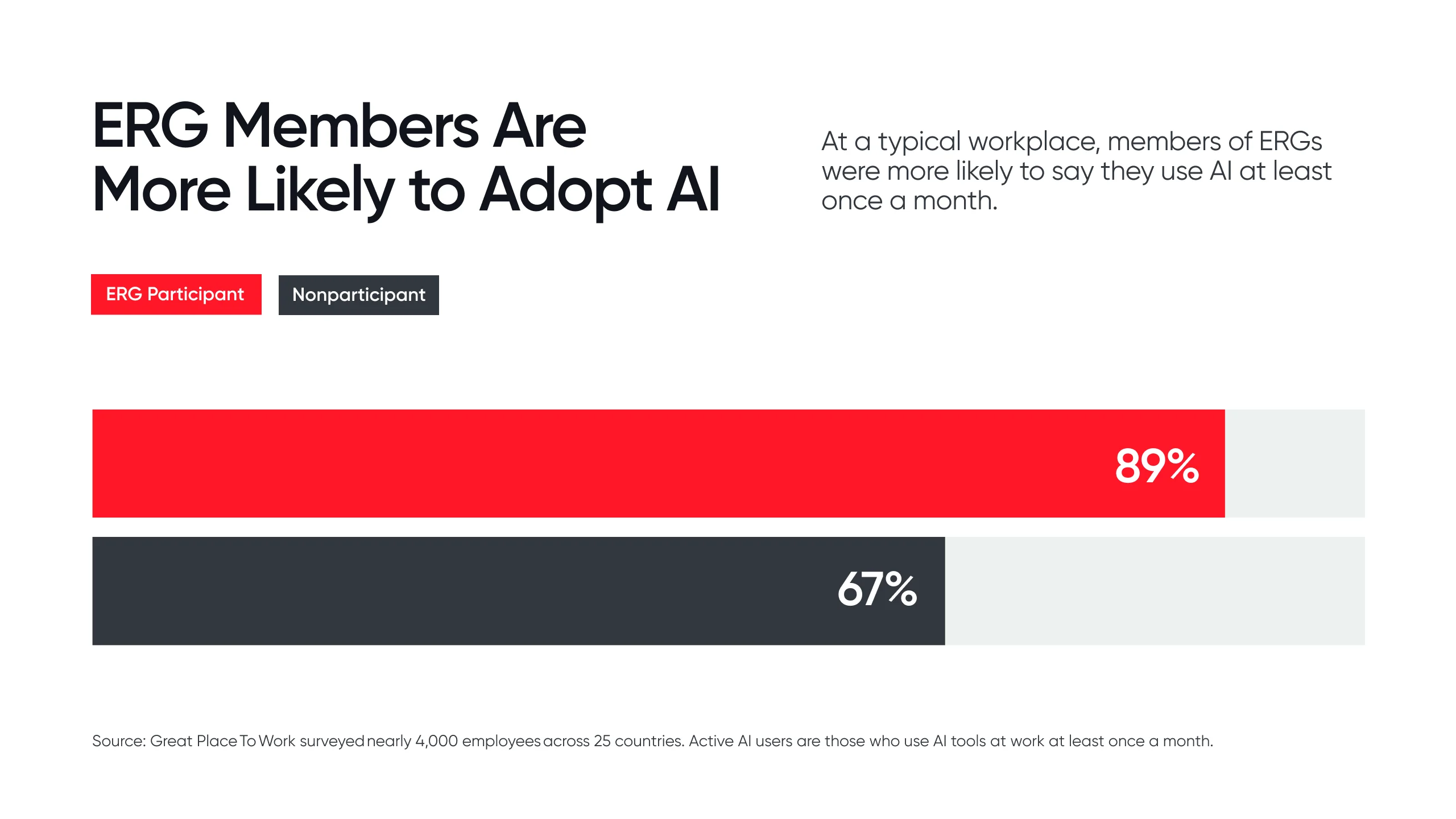
That finding lines up with Great Place To Work research on the untapped potential of employee resource groups. ERG members volunteer their time to strengthen the organization, share what they have learned, and seek out new ways to grow. For any organization pursuing AI transformation, that energy is a ready-made engine for experimentation and peer learning.
Why Trust Makes Organizational Change Stick
The second lever is communication that is both clear and empathetic.
When employees believed their leaders encouraged AI use, they were 2.5 times more likely to use it monthly. When they felt leaders had explained how AI could benefit their careers, they were 2.1 times more likely to use it.
Trust shapes how people respond to organizational change more broadly. In typical workplaces, just 15% of employees described themselves as change enthusiasts and 35% as open to change. Among 70,000 employees at high-trust organizations recognized by Great Place To Work, 36% were enthusiasts and 43% were open to change. Only 5% of that group were reluctant adopters.
Building an AI Strategy That Reaches Every Employee
For leaders shaping their approach, four priorities stand out.
Start with trust. AI transformation depends on a foundation of trust. Invest in the everyday leadership behaviours that build it, and set out a clear AI strategy early. When trust is already in place, AI initiatives land with far greater impact.
Open AI training to everyone. Much of the gap between executive and frontline enthusiasm comes down to exposure. Nearly every senior executive uses AI monthly, and that familiarity fuels their confidence. Give every employee the same opportunity to build it through hands-on training and access to the right tools.
Be candid about what AI means for jobs. Addressing worries about job loss and shifting roles before they spread gives your AI strategy a sturdier footing. Share concrete examples of AI supporting people's work rather than replacing whole roles. Canadian evidence helps here: among businesses using AI in 2025, 89.4% reported no change in their employment levels.
Let peers lead the way. ERGs and similar networks show higher AI adoption partly because employees tend to trust their colleagues. These groups also build belonging and connection, which helps people feel supported enough to try something new.
Making AI in the Workplace Work for Everyone
AI in the workplace delivers its strongest returns when it reaches beyond the leadership team. Organizations that pair broad access with trust, honest communication, and peer support give every employee the chance to contribute the effort, agility, and commitment that drive performance.
Wondering where your people stand? The Trust Index™ Survey measures the employee experience behind your AI ambitions, and the Great Place To Work Effect shows how that trust translates into business results.
This article is an adaptation of the original Great Place To Work®, written by Ted Kitterman, Content Manager, and Chandni Kazi, Data Scientist.
Feedback
Your feedback matters to us! Have feedback? Fill out this form by clicking here.
Ready to earn Great Place To Work Certification™?
Start your journey today and showcase your culture to the world.
People Also Asked
How is AI used in the workplace?
Among Canadian businesses using AI, the most common applications are data analytics, text analytics, and virtual agents or chatbots. For individual employees, everyday uses include drafting, summarizing, research, and handling routine tasks so more time goes to judgment-heavy work.
Does AI increase productivity in the workplace?
The Canadian evidence is encouraging. Firms using AI show noticeably higher labour productivity than non-users, and the gains are strongest when AI is paired with complementary investments such as staff training and sound data practices.
Will AI replace humans in the workplace?
Current Canadian data suggests augmentation far more than replacement. The large majority of businesses that adopted AI report no change in employment levels, with AI taking on specific tasks while people keep ownership of the wider role.
How should organizations train employees to use AI?
Make it hands-on, role-specific, and open to everyone, not only leaders. Pair formal training with time to experiment and with peer networks such as ERGs, where employees can share practical uses with colleagues they already trust.
Does a workplace need an AI policy?
A clear policy gives employees the confidence to use AI well. It should name approved tools, set expectations for protecting data and privacy, and explain how AI fits into roles, which also eases concerns about job security.
What are the pros and cons of AI in the workplace?
The upside includes faster analysis, higher productivity, and more time for meaningful work. The risks include uneven access, anxiety about jobs, and privacy concerns. Broad access, transparent communication, and a high-trust culture tip the balance toward the benefits.
Frequently Asked Questions:
Why do active AI users matter for business performance?
Employees who use AI at least monthly are more likely to give extra effort, adapt quickly to change, and want to stay with their employer. Those behaviours are core drivers of the Great Place To Work Effect, the measurable link between culture and financial results.
Why is AI enthusiasm stronger among executives than frontline employees?
Access and exposure. 82% of executives say they have AI tools that help them work better, compared with 48% of frontline managers and 38% of individual contributors. Nearly every executive uses AI monthly, and that familiarity builds confidence.
How can employee resource groups support AI adoption?
ERG members are more likely than their colleagues to use AI, partly because employees trust their peers. ERGs give organizations a volunteer network for experimenting, sharing practical uses, and building the belonging that makes people willing to try new tools.
What can leaders say to encourage AI use?
Be direct and make it personal. Employees who believe leaders encourage AI use are 2.5 times more likely to use it monthly, and those who hear how AI could benefit their careers are 2.1 times more likely to use it.
How does trust affect readiness for organizational change?
In high-trust organizations, 36% of employees are change enthusiasts and 43% are open to change, compared with 15% and 35% in typical workplaces. Only 5% of employees in high-trust environments are reluctant adopters.
How widely do Canadian businesses use AI?
Statistics Canada reports that 19.2% of businesses used AI to produce goods or deliver services in the second quarter of 2026, roughly triple the rate recorded in 2024.