

Key Takeaways:
- Candidates now interview employers almost as closely as employers interview them, so organizations need a clear, credible answer to what they stand for.
- Retention starts in the hiring process: when a role doesn't match what was communicated during recruitment, a trust gap opens before day one.
- Across generations, employees want the same foundations (meaningful work, supportive managers and a real growth path), even if growth looks different at each career stage.
- With 30% of poll respondents naming mid-career professionals as hardest to attract, followed by leaders and managers, developing leaders internally through succession planning and knowledge transfer is becoming essential.
Talent Attraction and Retention: What Employees Want and How Leaders Can Deliver
Talent attraction and retention are being reshaped by a clear shift in what people expect from work. Flexibility and well-being, once promoted as perks, are now part of how candidates judge an employer before they apply. Indeed research shared during this Great Place To Work® Canada Insights Webinar, presented in collaboration with Indeed Canada, found that 96% of job seekers want to see information about workplace well-being when they search for a job, and 88% say their happiness at work affects their happiness at home.
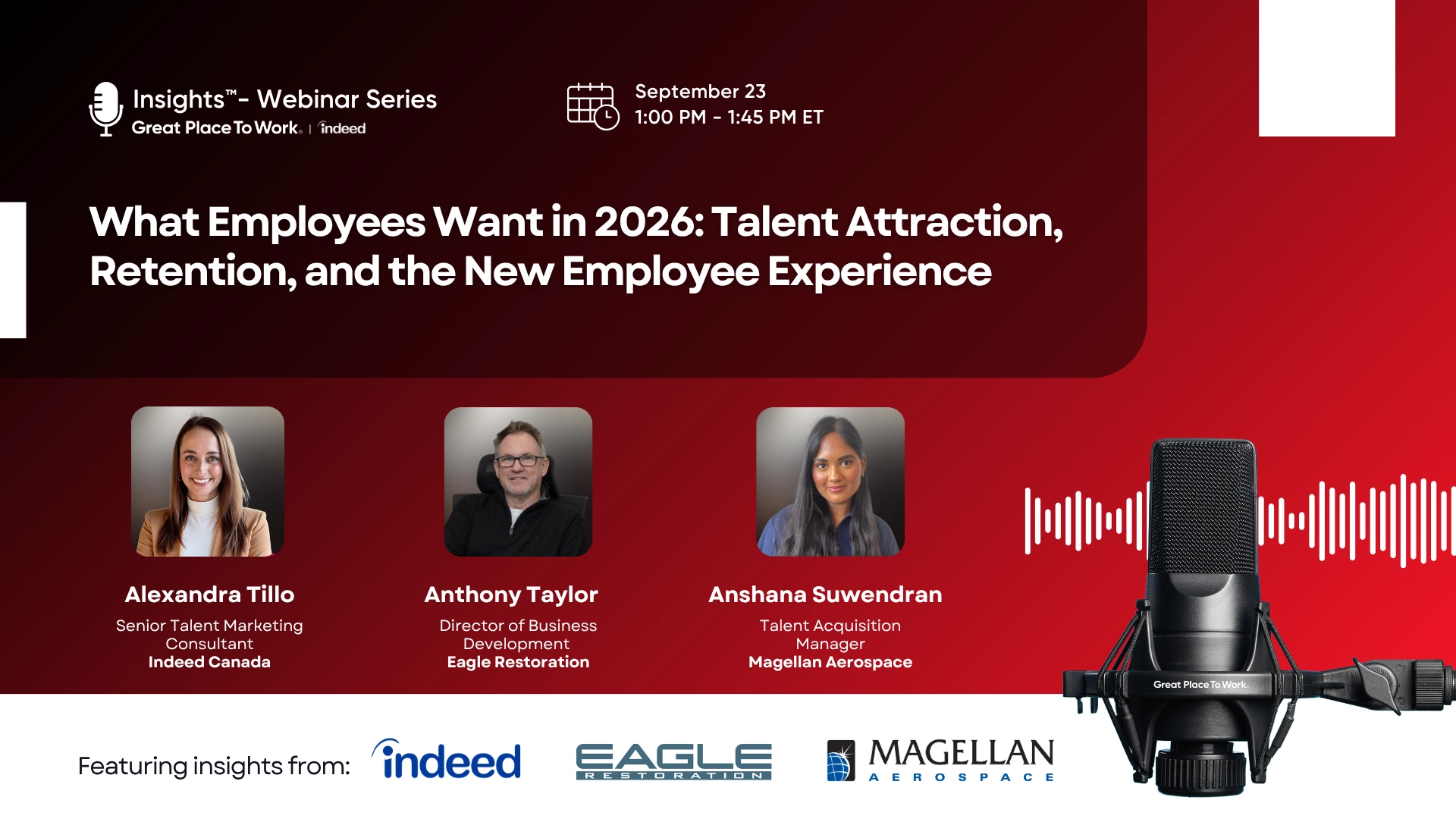
The session was co-hosted by Anne Cesak, Senior Consultant at Great Place To Work® Canada, and Alexandra Tillo, Talent Marketing Consultant at Indeed Canada, with panelists Anthony Taylor, Director of Business Development at Eagle Restoration, and Anshana Suwendran, Talent Acquisition Manager at Magellan Aerospace. Despite very different pressures, their advice pointed in one direction: people stay where the experience matches the promise.
Flexibility and Well-Being Are No Longer Perks
Tillo noted that around the pandemic, flexibility and well-being often appeared in job descriptions and employer branding as incentives. “But today, they’re the expectation. It’s not a perk,” she said. Employees now evaluate opportunities beyond compensation and title, looking closely at support, growth and belonging, and those expectations continue long after an offer is accepted.
Candidates are also doing more homework. Taylor observed that people coming through the door are now interviewing Eagle Restoration almost as closely as the company interviews them. Cesak added that candidates may now research employers with AI tools, so well-being information needs to be easy to find.
Transparency is raising the bar as well. Suwendran pointed to Ontario’s pay transparency changes, which put compensation ranges in front of candidates and current employees alike, and to the requirement to update interviewed candidates within 45 days. Both create new moments where the candidate experience can build or erode trust.
Talent Attraction and Retention Start Before Day One
Tillo argued that retention begins in the hiring process, not after onboarding. As she explained, “if the job doesn’t match what was communicated during recruitment, companies are already creating a trust gap before someone has even had their first day at work.”
From there, clarity matters. New employees need to know what success looks like, who they can turn to for support, how they can grow and how their work connects to the bigger picture. The earlier organizations answer those questions, the easier it is to build belonging, commitment and trust.
Leaders Who Walk the Talk
Taylor shared that Eagle Restoration’s community involvement, including work with a women’s shelter, was a key reason he joined. Tillo connected this to leadership: employees don’t need a leader with all the answers, but one who provides clarity, communicates openly, listens and shows that the company’s stated values reflect how it actually operates.
Different Generations, Shared Expectations
Suwendran observed that regardless of generation, employees want meaningful work, a supportive manager and a real growth pathway. Tillo agreed that values overlap far more than they differ; what changes is how growth looks. Early in a career it may mean new skills or a mentor. Later, it may mean more autonomy, leadership opportunities and new ways to apply expertise.
Cesak added that recent research ranks meaningful work, psychological safety and confidence in the executive team as the top three motivators for Gen Z. Tillo also noted that many younger employees define leadership differently, valuing horizontal progression built on skills and purpose over a climb toward a title.
Building Leaders From Within
In a webinar poll, 30% of respondents named mid-career professionals as the hardest group to attract, followed by leaders and managers. Cesak’s response was direct: if organizations cannot find leaders externally, they need to develop them.
At Magellan Aerospace, that means a global leadership development program, supervisory and technical skills training, and structured succession planning that shows new hires where they can go and what it takes to get there. With an aging workforce, Suwendran stressed that documented knowledge transfer is essential.
Where Organizations Can Act Now
The panel’s closing advice offers a practical starting point:
- Be clear about who you are. Taylor encouraged organizations to be as upfront about what they stand for and support as they are about the skills a role requires.
- Use your data. “The data doesn’t lie; the numbers don’t lie,” said Suwendran, pointing to Magellan’s triennial engagement survey and the feedback it returns to local managers.
- Focus on experience, not programs. Tillo cautioned against launching initiatives simply because they are trending, since employees live the experience through their managers, workload and daily interactions.
Across very different industries, the message was consistent. Talent attraction and retention depend less on the latest perk and more on whether leaders deliver the experience they promise, from the first interview to the everyday realities of the role. Organizations that listen, measure what matters and act on employee feedback are best placed to build the trust that keeps people.
Tools and Resources
- Employee Survey: Measure how employees experience trust, growth and well-being in your workplace. Use the results to act on what matters most to the people you want to keep.
- Employer Branding: Show candidates what your organization stands for with credible, employee-backed proof. Help job seekers see the experience before they apply.
- Recruitment: Strengthen your candidate experience and reach people who share your values. Build a hiring process that sets clear, accurate expectations from the start.
- Leadership and Development: Equip managers to lead with clarity, open communication and trust. Develop the next generation of leaders from within your own organization.
Transcript lightly edited for clarity and readability while preserving the speakers’ meaning and conversational tone. Anne Cesak: All right, welcome everybody. I see some people are continuing to join us, and I’m just looking at where people are calling in from. Looks like we’re well represented across this whole beautiful country of ours. Welcome to our September Insights Webinar. This is the next in our series where we’re taking a look at something we call the Great Place To Work® Effect, and this is a conversation with HR and leadership professionals sharing stories and some learning that you can apply right away. It’s going to be a conversation. I want to say thank you for taking the time to join today. My name is Anne Cesak. I’m with Great Place To Work. I’m a senior consultant here, a Certified Human Resources Leader here in Ontario, and I’ll be interviewing our panelists and having this great conversation. So, Great Place To Work: our mission is to build a better world by helping organizations become great places to work for all. We do that by providing tools to assess the experience of your employees and resources to act on that data. It’s so important that when we ask people how it’s going, we act on that feedback. And we believe that trust is really at the heart of an exceptional workplace. Before we start, just a few things to note. Please use the Q&A if you do have questions. We will leave time to respond at the end. We’ve got 45 minutes set aside today, about 35 minutes with the panelists having that conversation, and then we’ll leave time for those questions, or if it seems appropriate, we will address them throughout. My colleague Merve is behind the scenes supporting us today. Thank you, Merve. So again, use that Q&A, and use the chat as well if there are things that you want to share with each other. Anne Cesak: So, as I said, our theme for this year is the Great Place To Work Effect. I’m just going to share a couple of slides to get everybody grounded in what we’re talking about when it comes to the Great Place To Work Effect. Make sure I share the right thing here. There we go. I’m going to make this bigger. So, the Great Place To Work Effect: what is it? What are we talking about? Well, first of all, Great Place To Work defines a great workplace as one where people trust the people they work for, they take pride in the work that they do, and they enjoy the people that they work with. That is how we define a great place to work. The Great Place To Work Effect builds on that, and you can see it here. Great starts with leadership. Some recent data says that 70% of an employee’s experience is related to leadership: the organizational leadership and the person they report to, their individual manager. So that’s a big chunk, right? So great starts with leadership. Why are leaders important? Because leadership creates experience. That day-to-day experience that employees are having is shaped by leaders. And why is experience important? Why do we talk about experience? Because experience shapes culture. If you’ve heard me speak before, you’ve probably heard me say that culture is an outcome. It’s an outcome of the behaviours we reward, encourage, ignore. It’s the norms and traditions in an organization. It’s how stuff gets done around here. And then why is culture important? Why do we talk about culture? Because culture ultimately drives performance. Whether you are a for-profit, nonprofit or charity, you have key performance metrics that you track regularly and report on, and the culture that you create, and that the employees are contributing to, determines your performance. I’m just going to go to this next slide and build this out a little bit. So again, great starts with leadership, and we have identified what we call nine high-trust leader behaviours. You can see them listed here. We’ve done a number of webinars already this year focusing on a few specific ones: listening, speaking, inspiring, caring, developing, thanking, sharing, celebrating and hiring. These are the nine high-trust leader behaviours. And again, that leads to the experience. This is where we look at trust. What is the experience that is being created by leadership in developing trust in leadership? Then there’s pride, pride in the work that we do, the camaraderie, and really critical as well is “for all.” It’s one thing to be a great place to work on average, and it’s another thing to be a great place to work for all: regardless of who you are or what you do in an organization, you are able to contribute fully and feel valued for those contributions. So that’s the experience piece. Then there’s culture. I talked about culture as an outcome. Some organizations will say we have a culture of collaboration, innovation, agility, opportunity, well-being, belonging, lots of other ways to describe your culture. And ultimately, that culture supports performance metrics. There are some listed here. In your organization you probably have your own that you track, but it’s profitability, productivity, efficiency, customer satisfaction, social impact, market resilience, talent acquisition (we’re going to be talking about that today) and retention. We’re talking about both of those today and how critical those metrics are in understanding the culture that we’re creating. Anne Cesak: So I’m going to stop sharing and go back to my notes to make sure that we are moving along. I really want to introduce our panel today. Thank you so much for being here. Nobody wants to sit here for 45 minutes and listen to me talk. I’m really pleased to welcome Alexandra Tillo from Indeed Canada. She’s a talent marketing consultant, and Indeed, if you’re not aware, is the world’s number one job site and a global leader in job matching and hiring, operating in over 60 countries. I think many of our participants today are probably very familiar with the brand. Anthony Taylor is with business development at Eagle Restoration, one of southern Ontario’s most trusted companies in building envelope and parking structure restoration. And then Anshana Suwendran is the talent acquisition manager at Magellan Aerospace, a global integrated aerospace company that provides complex assemblies and system solutions to aircraft and engine manufacturers and space agencies worldwide. So we’ve got a really interesting panel today, very diverse organizations that you work with, so we’re going to have a great conversation. Anne Cesak: The first thing I like to do in these webinars, just to open up and get people feeling comfortable, is ask each of the panelists one question. So I’m going to go to each of you. What is taking up space in your brain right now when it comes to employee experience, talent acquisition and retention? What are the things that you’re seeing in your organization? Anthony, I’m going to start with you. Anthony Taylor: Sure. So, this year has obviously been a different year for a lot of people, in the sense that the people that we’ve been talking to, business-wise and employee-wise... at the beginning of the year, there were so many people coming in looking for work, and it was one of those times where we had to evaluate bringing in people when it was due time, because obviously the number of people that were coming in was far greater than the work that was being given out. Anne Cesak: Okay. Anthony Taylor: We have the basics as far as our setup, and that doesn’t change other than adding people, but it’s making sure we have the right workplace and work environment in general for whoever we bring in, which, like I said, hasn’t changed. Anne Cesak: Okay. And I know we’re going to learn more about all the things that you do in creating that great workplace. Anshana, how about you? What’s rattling around in your brain? Anshana Suwendran: A lot on our mind in terms of talent acquisition. It’s a huge year for us looking forward, as we’re getting a lot of government investments and looking to hire so much. We’re looking at a need that really is unprecedented in the last couple of years, especially with the pandemic. We’re so excited for growth. So it’s really looking at the pipeline that we’re going to be building in the future and making sure that we are building our capabilities for the next 5, 10, 20 years. We need to make sure that we have that technical talent available for us. Also keeping in mind, we are a defence organization, so we’re very limited in who we can hire, on the skill set side and on the security clearance side. So we’re looking at every pathway that we can build to bring that talent in. Anne Cesak: Awesome. Okay, thank you. And Alex, how about you? Alexandra Tillo: For me, it’s more what I’m hearing in the field. I’m talking to job seekers, employees and employers, and what I’m hearing, especially over the last year or two, is a lot of uncertainty on both sides of the marketplace, if I can say so. On the employee side, what I’m hearing the most is a lot of questions about skills. Are the skills I have right now still relevant? What type of skills do I need to acquire? A lot as well around growth: when joining a company, or even already within a company, is there any opportunity to grow, and if yes, what are they? And then from the employer standpoint, a lot of conversation around what a good employee experience actually looks like in an uncertain environment. We have employers trying to balance productivity, there’s a lot of cost pressure as we all know, there’s new technology as well, and at the same time they need to attract and retain talent. So yes, I think that’s the word on the street right now. Anne Cesak: Yeah, absolutely. And I can echo that. I’m hearing that a lot around this uncertainty and how you provide certainty to people. And certainly, looking at the industries represented here today: looking at growth right now as well as maybe 5, 10, 20 years out, and also managing, okay, do we have enough work for the people that we have? So, very different environments. Anne Cesak: What I’d like to do now is do a poll, to get our participants thinking about what’s going on out there for them as well. Merve is just going to bring that up. There we go. If you could only pick one, which trend is having the greatest impact on your talent strategy today? When you think about the people that you need to join your organization, what’s having the greatest impact? Generational differences in employee expectations, AI and automation, skill shortages, employee demands for flexibility, or retention and turnover? So when you’re thinking about your own talent strategy, what is having the greatest impact right now? We’ll give people a minute or two and we’ll see. Alexandra Tillo: Some of them want to pick everything, probably. Anne Cesak: Yeah, sorry, I didn’t give that option. That’s right. There are good options. Alexandra Tillo: Yeah, it’s true. Anne Cesak: There can be more than one. Absolutely. Okay, we’ll just give it another couple of seconds. Okay, Merve, if we can get you to close that, let’s see. Okay, so very evenly split. Maybe people didn’t want to pick more than one. We actually have a tie for first: AI and automation, and skill shortages. Then number two, very close behind, is employee demands for flexibility, and retention and turnover. So that’s impacting people’s talent strategy. And last was generational differences in employee expectations. So there doesn’t seem to be one clear-cut thing that’s impacting people. Alex, to your point, it could be all of those things, and probably is. Anne Cesak: Okay, back to our panelists. Alex, I’m going to start with you. The question is, what do employees want now? I’m saying 2026, and we’re almost in 2027, so today and maybe in the near term. What are they looking for that they didn’t necessarily expect two to three years ago? If we think back a few years, we were coming out of COVID. So what are you hearing from employees and employers about what they’re looking for? Alexandra Tillo: It’s a good question, because it does evolve, but there’s always a trend. I think one of the biggest shifts is that employees have become much more intentional about the overall experience they want from work. A few years ago, and I’m sure a lot of people who are here with us today remember, around the COVID time, the conversation was a lot about flexibility and well-being, but they were often framed as perks. I remember reading a lot of job descriptions, because we could see them evolve, even EVPs or employer branding, and those were perks to attract people. But today, they’re the expectation. It’s not a perk. I can give you some stats. We do a lot of reports at Indeed, and we’ve done work well-being research. We have 96% of job seekers who told us they want to see information about workplace well-being when they’re searching for a job. So as soon as they’re interested in a role and they see a company, right away, 96% of them want to know what the company is doing for the well-being of its employees. And within that survey as well, we had 88% of people who said that their happiness at work affects their happiness at home. So I really think employees are increasingly evaluating an opportunity beyond compensation and title. They want to know about support; yes, flexibility again, as an expectation; growth opportunity; and belonging as well is a really strong indicator. I think that’s a really important shift for employers, because those expectations don’t disappear when someone accepts the job. They really continue throughout the employee experience. So it’s not so much a nice-to-have anymore. It’s really part of how people evaluate employers. Anne Cesak: For sure. Thank you for that insight. I think that’s a really good nugget for people to take away when you’re thinking about your employer brand and how you’re sharing that with people. The first thing somebody does is, well, I was going to say go to a website, but you might use an AI to get more information about that organization. If well-being is proving to be important for employees, then we’d better make sure that the AI can find that information, right? So, Anshana, how about Magellan, or in your experience? What are employees looking for? Anshana Suwendran: Yeah, a major shift that we noticed recently is really around pay transparency. There have been a lot of changes and updates in legislation, specifically in Ontario, that rolled out in the last year. That’s really changed the game for us, because you have candidates seeing the compensation range, of course, but also your own employees. So it’s opening up a lot of conversations internally about people’s compensation, and sometimes those conversations can be tough. But my VP of HR always says compensation is a variable at a specific time T, at a specific place P, for experience E. There’s just so much that goes into it, and into the reason why someone is at a certain amount in a range. So those conversations are happening, and we’re coaching our HR employees as well. And specifically on the hiring process in Ontario: if someone has been interviewed, you have to give them an update on whether the role is open or not within 45 days. So people really are following up, we’re noticing, and we also have to make sure we’re not losing candidates in that process. Anne Cesak: Wow. Okay. Yeah, thank you for sharing that, because you’re absolutely right. Certainly from an Ontario perspective the legislation has changed, and I believe in other provinces as well there are those requirements. So it definitely adds another opportunity for organizations to impact that candidate experience: how are we interacting with people throughout that talent attraction phase? And Anthony, how about you? What are you finding that employees are looking for now that maybe they weren’t a few years ago? Anthony Taylor: I guess the big thing I’ve found that has changed, and I never would have imagined I’d be seeing this, is that employees coming through are interviewing us almost the same as we’re interviewing them. I’m an old-school guy. I came in applying for a job, doing my best and keeping my fingers crossed. So I would never have imagined being interviewed by someone walking in. Just like how every day we have to go out and sell to potential customers, it’s being reversed on us. It’s definitely new. And thankfully, I can speak with confidence, at least for us, about the stuff that we do, what we support and the environment. I’m definitely very confident in it. But I just couldn’t imagine there would be a time when I’m being interviewed for them to come work here. Anne Cesak: Yeah, that’s a great insight. Candidates are interviewing you as much as you’re interviewing them, because it’s got to be mutually beneficial. That employee wants to appreciate what it’s going to feel like working here before they can make that decision. Anne Cesak: And you bring up an interesting point, so my next question is about generational differences. I think you used the term “old school,” which I would not encourage, but we can all acknowledge that we are probably from different generations. So let’s have this conversation about generations. It’s really about experienced talent and young talent, and what are we seeing in the marketplace today when it comes to that. Anshana, I’m going to go to you first. I know that you are looking to hire a lot of people, so give us your perspective on that. Anshana Suwendran: Yeah, I think there’s a lot of talk about the different generations. We’re seeing one generation exit and another generation come in, and they experienced a very different work experience with the pandemic, so there are a lot of gaps that they’re also adjusting to. But in terms of career expectations, I don’t think there are a lot of differences. At the end of the day, employees, regardless of what generation they’re in, just want to have meaningful work, to make sure that their manager is supporting them, and that they actually have a growth pathway at the organization. Regardless of your experience, you want to make sure you have those same items, but also, if you have all this experience, that the business is actually valuing you for it. So that might be a difference there. But other than that, I think there are a lot of common themes. Anne Cesak: Yeah, absolutely. And Alex, how about you? Do you have any research, or what’s your perspective? Alexandra Tillo: Yeah, I agree so much with what Anshana just said. When I look at all the research we’ve done at Indeed, I’m more surprised by what they have in common than by the differences. There’s this common thought that the younger generation is looking for flexibility or rapid progression, which I’m not saying isn’t true, but it’s not the only thing. And sometimes we almost assume that experienced employees just want stability. But when you actually look at the values, they overlap a lot. Everyone wants to work somewhere they can do good work. I actually saw someone in the chat, asking about a trend towards community impact. I’m reading it at the same time because I think it’s very relevant. They said they notice people are often applying because they know how much their company is giving back, and I do think that’s something that’s very common across generations right now. People want to do good work, have that impact, feel respected, and see a future for themselves, regardless of generation. So I think the difference is often how it looks in practice. What I mean by that is, for someone early in their career, growth might mean learning new skills or having access to a mentor, for example. For someone who’s more experienced, growth might mean more autonomy, leadership opportunities, and applying their expertise in new ways as technology is coming in. So I do think it’s just a matter of how it looks for them, but the ground is the same. What they’re looking for is the same; it just looks a bit different. Anne Cesak: Yeah, for sure. And Anthony, how about you, from a generational perspective? Anthony Taylor: Talking to a lot of people who have come through this year, people want to know the direction. I compare it to a GPS: we use Waze or Google for everything. And they want to know, okay, what’s my potential? I know what I have to offer you. Like the other panelists said, where can I grow from here? And I keep hearing this: they want to have a voice. They want to have a seat at the table when we have certain discussions, because we believe there’s no use asking a bunch of management questions about the outside workers. Why not ask them? So that seems to be the common thing. And I’m fortunate enough to have four kids, from 29 to 38, all in different roles, and my oldest son educates me all the time about the difference today. Typically, I stayed 20 years at each company I was at, and he’s saying, “Well, it’s a little different, Dad. We need to see what you have to offer and where I can grow, and if you’re going to keep me stagnant, then maybe I need to look elsewhere.” So I get educated all the time. Anne Cesak: Thank you for sharing that. I can certainly relate. Our research at Great Place To Work shows, and Anshana, you talked about the common thread, that the common thread we see is around purpose. Why am I doing this work? Who are we as a company, what are we doing, why are we doing it, who are we impacting at the end of the day, and how does my role impact the end consumer of the work that we do? I came from a B2B organization where you didn’t necessarily understand the end beneficiary of the work. So for organizations, how can we explain that? In all organizations, but certainly in business-to-business, where you don’t necessarily understand the end consumer, it can be so impactful to explain, if you’re making something, who’s going to be using it at the end of the day and what impact it’s going to have. So that was one. And some recent research around Gen Z: the top three motivators are, number one, meaningful work, which we’ve talked about as actually common across many generations. Number two is psychological safety, and number three is confidence in the executive team. Who is leading this organization? What is the vision? Where are we going? And then the psychological safety piece: we actually did another Insights Webinar on that, so I won’t spend too much time on it. But can I ask a question? Can I have a different opinion? Can I be myself? There are so many things wrapped into psychological safety, and do people feel that they have that in their organization? So again, that was just one recent research study. Anne Cesak: Okay, so the next topic we’re going to talk about is really around retention. We talked about perks, and those aren’t the things that are really driving it. So let’s have more of a conversation around what people are looking for. We talked about purpose, but you work with people at different levels in the organization. What are you really experiencing from people about retention? We get people in the door, we do an onboarding, they’re settled, but what do we need to do? We talked a bit about growth, but let’s get a little more specific about that. Alex, I’m going to go to you. Alexandra Tillo: Yeah, it’s a great question, because I actually think, and you made the link here, that retention starts before day one. It starts from the onboarding process, not even onboarding, the hiring process. It starts from the expectations the job seeker, slash new employee, has and what the company is giving them. That’s linked to what Anthony was saying earlier about how much a company is now being interviewed as much as a job seeker is. I do think those expectations come from both sides and need to be set very early on in the process, because if the job doesn’t match what was communicated during recruitment, companies are already creating a trust gap before someone has even had their first day at work. The second piece that I would say is very important and has a massive impact on retention is: is it clear what success means at your company? What does good performance look like? Who can they go to for support? How can they grow in their role? And, as we were saying about values, how does their work connect to the bigger picture? The earlier companies answer those questions, the easier it is to build that sense of belonging, commitment and trust, and that has a massive, massive impact on retention. Anne Cesak: Love that. It’s not one point in time. It’s a whole spectrum. And actually, Anshana, I’m going to ask you, excuse me, to build on that from a leader development perspective. How do we develop leaders? Because we’re talking about how employee expectations may have changed. So how are we developing leaders now to lead the people who are now coming into our workforces? I’ll let you answer that one. Anshana Suwendran: Yeah, we always like to say no one’s really born a leader. You have to mentor them and coach them, if that’s an aspiration and there is that opportunity in the company. But it’s like a toolbox, right? So it’s investing in them. Magellan has a global leadership development program. We offer supervisory skills and technical skills training. We are in an aging workforce, and we do need to fill that gap, but it’s also a huge opportunity, with those roles opening up. So we’re looking at structured succession planning, which is so huge, because you’re telling the new hires coming in: this is your plan. In X number of years, once you complete X number of skills and qualifications, you can go here. And having that documented knowledge transfer is huge. So yes, I think there’s just so much opportunity there. Anne Cesak: I think that’s really key. I’m just going to jump on that knowledge transfer piece, because when we think about generations, you’ve got experienced workers who have that knowledge, and a lot of it is just up here. So how are we dealing with that knowledge transfer? How are we ensuring that subsequent generations are learning? And I’ll talk about AI for just one second, because we’ve heard that there may be entry-level roles that will be replaced with AI. Whether that’s true or not, we’ll wait and see. But when we don’t bring junior-level or entry-level people into those roles, how do they learn? Because people will transition out of the organization. So it’s ensuring that those people are coming in and learning both through experience and from the generation that might be leaving. And also, when we look at longevity, people are living longer, people want to work, and people have a lot to contribute. I’m actually doing a webinar tomorrow about managing intergenerational teams, so I have this on the brain right now. Let’s balance this need to develop people as well as retain people. So Anthony, I’m going to go to you now, again talking about this whole retention piece. From your workforce perspective, what are some of the challenges that you’re having, and what are you thinking about retention? Anthony Taylor: Well, for us, we are pretty well a year-round company when it comes to events. I’ve never had this in the past, other than my experience at Air Canada a long time ago. We do so many various events that involve the employees and customers too, so we have this interchange constantly. We must have at least five events. And it’s interesting, because we’re involved with a women’s shelter downtown, and yesterday the vice-president and I were there, and they asked this question: why do you get involved? Why do this? And I said, you know what, number one, employees want to see that you aren’t just interested in buying a newer car, a nicer car. To me, that is the past. They want to see what you stand for, what you support, who you volunteer with. Our philosophy has never been about just writing a cheque. We’re involved in so many different things, and that was one of the reasons why I came here. So retention: going on a year and a half to two years being here, it definitely was the selling feature for me, because, like I said, I’ve had two careers. I wanted to go to a company that really sees above and beyond our main thing, that there is something else outside of us that brings us all together, which is really exciting. Anne Cesak: Yeah. And... Alexandra Tillo: Sorry. Anne Cesak: Yeah, go ahead. Alexandra Tillo: It’s a great point. Retention and leadership. I’m trying to remember the English expression: is it “talk the talk, walk the walk”? It’s something people are looking for, 100%. It’s true that leaders set the pace of the company. What you just described, your VP going to a women’s shelter, is really showing that it’s not just a nice employee value proposition line about what we’re doing in the community. It’s actually doing it and showcasing that you’re doing it. I think it goes a long way to have leaders so involved and showing the way. And again, we’re talking about all generations, and I think it’s true for everyone. Talking with all the job seekers and having all those surveys out, employees don’t necessarily need a leader who has all the answers. They want a leader who provides clarity, communicates openly and listens, and who creates the conditions for people to feel like they belong and to give their best at work. So I think it’s really less about “I’m the leader, so I know everything,” and more about building that trust, and showing that what you’re putting on paper is actually the way you live and the way you, as a leader, are taking action on those words. It’s really, again, building that trust and helping people really live in the company. And again, for retention, I think it’s a great way of getting people into the company and having them stay, because they can trust you as a leader. They can trust the company’s words. Anne Cesak: Yeah. And I think that goes back to what we were talking about earlier around employees interviewing organizations. Now that you’ve shared that nugget around what you do for well-being, I think a lot of people want to know what this organization is giving back to the community where they work and live. It’s so important to people. And how can I get involved too? People want to have those opportunities as well. Anne Cesak: We’ve been having this great conversation. I was going to do another poll, but I’m not going to. Or, you know what, let’s do it, because I want to understand from our audience today what one challenge is that you’re having. So for this next poll, I’ll just get Merve to bring that up, please: which employee group does your organization find most challenging to attract right now? Let’s understand a bit about that, and you will have the option to pick all of them this time. You don’t have to pick just one. Merve is going to be pulling up that poll for us in just a minute. And I think we’ve been capturing the questions as they’ve been coming in. Alex, I know you’ve been looking at that. Okay, so here’s the poll. Which employee group does your organization find most challenging to attract right now? Early career, mid-career, experienced employees, leaders and managers, or do you struggle across all groups? A statistic that I saw recently was that younger generations actually don’t want to be leaders. And there’s a comment here: “Same, we are seeing the same thing,” from one of our attendees. So I think that’s concerning, and what can we do about that? Did you want to share anything more about what you’ve been hearing on that, Alex? Alexandra Tillo: Yeah, I think it’s just a different way they see leadership compared to other generations. Their goal is not necessarily to become a VP, the path that, I would say, boomers or even millennials followed. It’s exactly what Anthony and Anshana have been talking about: it’s really getting more involved and having that purpose, and working more towards that. They’re very happy having a horizontal progression, acquiring new skills and still being attached to that purpose and value. It’s not necessarily growing up towards a job title. That’s not what they care about. It’s more about developing their skills. So they see leadership a bit differently. I think they see leadership in someone who has different skills and has touched on a bit of everything, versus someone who stayed in their line but went up. I think that’s really interesting, and it says a lot about the younger generation as well and how much more open they are to the world. Technology does that, again, but I find it very interesting, and I think it will have, or already has, an impact on the type of roles companies are going to hire for and the type of skills. Anne Cesak: It’s a great insight for our participants today when you’re thinking about the future. If we do have a generation of people like that, Alex, you said it: it’s defining what leadership is in our organization. A lot of organizations are matrixed. They’re project-based too. So I’m not necessarily leading a department; I might lead a team. What are people looking for? How do we develop those skills? So Merve, do we have the poll? There we go, thank you very much. What employee group does your organization find most challenging to attract right now? The, I’ll say, winner: 30% of our respondents said mid-career professionals. Interesting. That was the most challenging to attract right now, followed by leaders and managers. So if we’re having trouble attracting leaders and managers, then I think it’s incumbent upon us as organizations to be developing leaders and managers. If we’re not going to be able to find them externally, we should be doing that anyway. And then we had some early talent, some experienced employees, and then “we struggle across all groups.” So some good insights there. Thank you, everybody, for participating in that. Anne Cesak: We’ve got a couple of minutes left, and I do want to give you all an opportunity to share. If you could give advice to the leaders and HR leaders out there who are participating today, just one piece of advice when it comes to attraction and retention. It’s such a meaty subject. Thinking about what’s going to matter in the next couple of years, what is one piece of advice you would give people in terms of how they are either retaining or attracting talent? Anthony, I’ll start with you. Anthony Taylor: Well, that’s a tough question. When I was thinking about this last night: the big statement a couple of years ago was that every company has to have a mission statement. There was a lot of talk about that. And I was thinking last night about the conversations I’ve had with people who have come in. Their skill is their skill; you know that already. But I would almost ask them to write a mission statement and bring it in, to see what they stand for and what they support. It’s a crazy comparison, but it’s similar to these dating profiles, right? You put right up front what you stand for, what you like, what you support, and it’s pretty black and white right up front. Assuming your skill set is all taken care of, you want to know what they stand behind and who the person is that’s coming through. At least, like I said once again, coming here, that was definitely my approach: finding out, okay, what’s Eagle Restoration all about? What kind of charity work do they do? Because that’s what I’m very familiar with. The actual work, the business development part, for me anyway, is easy. It’s relationships, which I’ve had for years. So I just wanted to know more about them than they probably wanted to know about me. Anne Cesak: Okay. So the insight there is really to be clear as an organization about who you are. Anthony Taylor: Yeah. Anne Cesak: And what you’re going to offer. And Alex, I believe you used the term EVP, that employee value proposition: the give and the get. So how are we in this together? And Anshana, how about you? What’s something that you would give people around attraction and retention? Anshana Suwendran: Yeah, being in recruitment, I always say the data doesn’t lie; the numbers don’t lie. I would say get some data. Your employees will give you feedback. Magellan just did our triennial, so every three years, employee engagement survey. So we just have a wealth of data on exactly what we need to work on, and we’re going back to our local managers and giving them feedback based on that. So that’s critical, and you’re going to get a lot of information to work towards. Anne Cesak: Love that. Yeah, at Great Place To Work, that’s what we do. Hearing from employees, asking, getting the feedback and doing something with it is so important. And Alex, how about you? Alexandra Tillo: I would say it’s advice to leaders, and again, working on the ground, I’m saying this: sometimes I feel that organizations focus a bit too much on the program itself rather than the experience. What I mean is, there are fantastic companies, and the intention behind it is very positive: they want to launch a new benefit program, a well-being initiative, a flexible work policy. But what about the actual employee experience? Employees live it through their managers, their workload, all the day-to-day interactions. So it’s trying to focus more on what it actually looks like for an employee. I think it’s really important, and you just spoke about that survey: it’s very helpful to understand the impact of the program you’re trying to develop, and to listen a bit more to employees rather than thinking, “Oh, that’s the new trend, I want a program around it, let me put something in place because it’s the thing to do.” And Anthony, you mentioned this as well: what does it look like for you as a leader, as a company? What does it actually mean for you? Really thinking more from an experience standpoint rather than just a program standpoint. Anne Cesak: I love that, Alex. I’ll call it the flavour of the month: this is the hot thing, the hot perk, whatever it is right now, let’s do that. Something that I see with some of our clients is that survey results will come back, and there will be disappointment around involving people, or maybe the benefits, or a number of different areas of the employee experience. A lot of times, employees don’t know what the organization offers, and we’re not measuring the impact of that. Alex, that is so important: not to throw the baby out with the bathwater, just thinking that something’s not working and bringing in something new. It could be a tweak, or it could be communication. Part of my portfolio before I joined Great Place To Work was employee communication, and it’s ensuring that people know what is going on. Leaders are such a critical channel when it comes to employee communication. One other thing I wanted to go back to, and Anshana, I know we’re at time, but you talked earlier about being happy at work and being happy at home, and I thought that was such a great insight. DHL is a client of Great Place To Work, and one of their senior executives was at a conference talking about how they personally feel responsible for somebody going home at the end of the day happy, because the experience that you have at work is going to impact the experience that people have when you walk through the door. So I wanted to come back to that. You can find that video online if you want to. I know, again, we’re at time. We could just talk about stuff like this, but one thing I wanted to say: in preparing for today’s webinar, we did ask people what they wanted to see covered, and boy, did people deliver. We got great feedback. If we didn’t cover your questions in today’s session, we will be looking at how we can incorporate them into another session, or please go back and watch some of our other Insights Webinars. We’ve done some with Indeed, so if you’ve been enjoying Alex today, we do have some other webinars that she’s participated in. Please connect with our panelists on LinkedIn. I want to thank everybody so much for participating today. This has been such a great conversation, and thank you, everybody, for coming back for another Insights Webinar. We really enjoy it. And we’ll be back in November. And Alex, I think you’re going to be back to join in November. Oh my gosh, it’s September right now. October. I think you’re going to be back with us in October. So please come back, everybody, and join us then. And again, thank you for being part of our mission to build a better world by helping organizations be great places to work for all. I hope that you enjoy the rest of your day. Thanks, everybody, for joining. Bye.Read the full webinar transcript
Full Webinar Transcript
Welcome and Introductions
The Great Place To Work® Effect
Meet the Panelists
What’s Taking Up Space in Your Brain Right Now?
Poll: Which Trend Is Having the Greatest Impact on Your Talent Strategy?
What Do Employees Want Now?
Generational Differences: Experienced Talent and Young Talent
Retention: What Keeps People?
Poll: Which Employee Group Is Most Challenging to Attract?
One Piece of Advice on Attraction and Retention
Closing Reflections and Wrap-Up