
Company Culture, Employee Engagement , Talent Acquisition, Training & Development
Key Takeaways:
- Employee development becomes a business strategy when it reaches every role, not only the professional and degree-holding groups where training participation runs highest in Canada.
- Internal mobility gets easier when every role is posted internally with the hiring manager and recruiter named, and when senior leaders talk openly about their own career paths.
- Continuous learning takes root when it fits the daily rhythm of work, through workshops, courses, podcasts, and conferences that suit different roles.
- Talent development from within works best through early-career programmes that rotate people across the business and do not require a degree.
- Continuous learning takes root when it fits the daily rhythm of work, through workshops, courses, podcasts, and conferences that suit different roles.
- Upskilling sticks in high-trust workplaces, where autonomy, support, and psychological safety let people stretch and treat feedback as a tool.
- Learning and development investment strengthens growth, adaptability, and retention, because helping people grow and helping the business perform are the same effort.
Some workplaces treat employee development as a perk that arrives once a year, tucked into a performance review. Others treat it as a core part of how the business grows. The second group tends to share a conviction: people do better work when they enjoy what they do, and enjoyment deepens when they can keep learning, moving, and taking on new challenges.
That conviction shapes the whole employee experience, from the first week to the tenth year. It shows up in how roles are posted, how managers respond to curiosity, and how leaders talk about their own careers. When it works, development stops being a programme that a few people qualify for and becomes part of the daily rhythm of work for everyone.
For Canadian HR leaders and people managers, the practical question is what organisations that get this right actually do differently. Four habits stand out: they make internal mobility easy, they grow talent from within, they build continuous learning into the working week, and they back it all with trust.
Why Employee Development Is a Business Strategy, Not a Benefit
Statistics Canada reports that about 3 in 10 workers (29.7%) took part in job-related training outside the formal education system in the 12 months ending in November 2024. The more telling detail is who gets access. Participation reaches 36.8% among workers with a bachelor’s degree or higher and falls to 16.8% among those with a high school diploma or less. It sits at 42.9% in professional occupations and 16.9% in jobs that do not usually require postsecondary education.
In other words, employee development in Canada often follows the job title and the diploma. Organisations that want a genuine advantage close that gap on purpose. The same Statistics Canada analysis notes that training does two jobs at once: it prepares people to take on more responsibility with their current employer, and it gives the business a boost in productivity and in how confident and motivated its people feel.
In workplaces where development is part of everyday work, employees describe a consistent experience. They are offered chances to grow, trusted to do good work without constant oversight, and treated as full members of the team whatever their position. That pattern matters because it shows development reaching everyone, not only high-potential talent or future leaders.
Making Internal Mobility a Leadership Priority

Internal mobility is where development becomes visible to employees. Workplaces that take it seriously tend to share a few habits:
- Open every role internally. Every vacancy is advertised to current employees and names both the hiring manager and the recruitment partner, so nobody has to guess who to approach. That small detail removes a barrier that quietly stalls internal moves in many organisations.
- Introduce people to unfamiliar corners of the business. Short rotations and exposure initiatives let employees see other functions and career paths before committing to one.
- Put senior leaders in the room. Open forums, hosted by senior leaders who share how their own careers unfolded and answer questions directly, make moving feel normal rather than risky.
- Make room for lateral moves and secondments. Growing the number of lateral moves and secondment opportunities from one year to the next signals that sideways steps are a legitimate way to build a career.
The payoff is a workforce that keeps moving, learning, and adapting. Performance improves, knowledge travels between teams, and talented people see a future close to home, which supports retention. That is talent development at its most practical: people grow into new roles instead of leaving to find them.
Futureproofing Through Talent Development
Employee development goes beyond courses and workshops when an organisation invests in its next generation of leaders and specialists. An early-career programme that runs for about two years, rotates participants through different parts of the business, and does not require a degree can build technical expertise, commercial awareness, and professional networks at the same time. Specialist tracks, such as risk, can pair technical qualifications with hands-on experience across several disciplines. When leadership teams keep asking for placements, it is a good sign the programme is earning its place.
The no-degree entry point deserves attention in Canada. As noted above, workers with a high school diploma or less take part in training at less than half the rate of workers with a bachelor’s degree, so programmes open to people from different educational backgrounds help close a gap the labour market has not closed on its own.
The lesson applies in every industry. The skills a business will need in a few years rarely appear on the market at the moment they are wanted, so the dependable route is to grow them from within. That takes sustained upskilling rather than a one-off push.
Continuous Learning at Scale, Fuelled by Trust
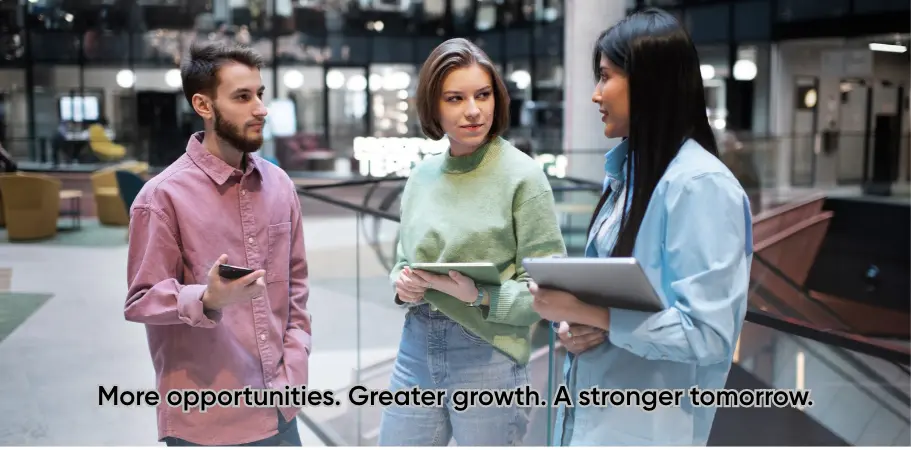
Continuous learning works best when it belongs to the daily rhythm of work rather than a date on the calendar. In the strongest examples, it takes many forms: workshops and online courses, podcasts and conferences, stretch assignments and peer conversations. Employees across the organisation invest meaningful time in learning each year, in formats that suit different roles and schedules.
Trust is the foundation under all of it. When employees complete a Trust Index™ confidential employee survey, high-trust workplaces tend to show strong autonomy, support, and psychological safety. That combination lets people stretch beyond their comfort zones, take on unfamiliar work, and occasionally get it wrong. Feedback is treated as a tool for improvement rather than a punishment, which keeps people willing to try again.
The Business Case for Employee Development
The lesson for leaders is straightforward: organisations that invest in employee development are often better positioned to grow, adapt, and keep their talent. Correlation does not prove cause, yet the thread running through development, mobility, trust, and results makes a persuasive case for strong learning and development practices.
As conditions grow more complex, the advantage often goes to organisations that learn and adapt faster than their peers. Growth for people and growth for the business turn out to be the same effort seen from two angles.
Ready to see how employees in your organisation experience growth and development today? Start with their perspective. The Great Place To Work® Trust Index™ Survey shows where learning and career opportunities are landing, and the Great Place To Work Effect explains how trust connects to business results.
This article is an adaptation of the original Great Place To Work®, written by Shalagh Fredericks, Head of Content and Community, Great Place To Work U.K..
Feedback
Your feedback matters to us! We are always looking for ways to make our content more useful for Canadian leaders. Have feedback? Fill out this form by clicking here.
Ready to earn Great Place To Work Certification™?
Start your journey today and showcase your culture to the world.
People Also Asked
What is employee development?
Employee development covers the training, experiences, and career moves that help people build skills and progress within an organisation. It includes formal courses, rotations, mentoring, and everyday stretch assignments.
What is continuous learning?
Continuous learning is the habit of building new knowledge and skills throughout a career, rather than only at the start of one. In a workplace, it shows up as workshops, online courses, podcasts, conferences, and learning built into daily work.
Why is continuous learning important?
Skills that a business needs rarely appear on the market exactly when they are wanted. Continuous learning lets organisations grow capability from within, keeps people engaged, and helps teams adapt as conditions change.
What is an employee development plan?
An employee development plan is a shared agreement between an employee and their manager that sets out the skills to build, the experiences to seek, and the roles to work toward. Regular check-ins keep it current and show progress.
How do you encourage employee development?
Make growth visible and easy to act on. Post every role internally, introduce people to other parts of the business, have leaders share their own career paths, and build a culture where trying something new and getting feedback feels safe.
How much time should employees spend on professional development?
There is no single number that suits every role. What matters is that learning is built into the working week and protected from competing demands, so it happens in the flow of real work rather than as an occasional event.
Frequently Asked Questions:
What is employee development?
Employee development is the set of opportunities that help people grow their skills and careers inside an organisation, from training and rotations to internal moves and early-career programmes. It works best when it is part of everyday work and open to every role.
Why does employee development give an organisation a competitive advantage?
It builds capability the business cannot reliably hire on demand. Organisations that invest in development are often better positioned to grow, adapt, and keep their talent, and training lifts productivity and the confidence and motivation of the people who receive it.
How can organisations make internal mobility easier?
Advertise every role internally and name the hiring manager and recruitment partner on each vacancy. Add short rotations, open forums where senior leaders share their career paths, and a steady supply of lateral moves and secondments.
How widely available is job-related training in Canada?
Statistics Canada reports that 29.7% of workers took part in job-related training in the 12 months ending in November 2024. Participation was 36.8% for workers with a bachelor’s degree or higher and 16.8% for those with a high school diploma or less, which points to real opportunity in opening development to every role.
What role does trust play in continuous learning?
Trust gives people the confidence to stretch beyond their comfort zones. Autonomy, support, and psychological safety let employees take on unfamiliar work, make the occasional mistake, and use feedback to improve rather than fear it.
How do early-career programmes support talent development?
A programme of about two years that rotates participants across the business builds technical expertise, commercial awareness, and professional networks together. Entry routes that do not require a degree widen the pool of future leaders and specialists.