


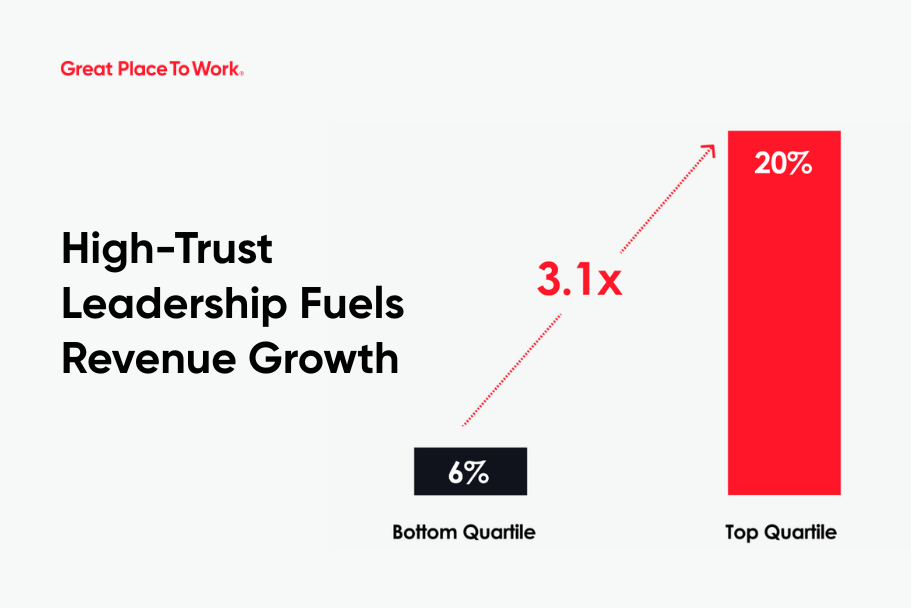

New data from Great Place To Work reveals a striking connection between how employees rate their leaders and how fast their companies grow.
When people trust the leaders they work for, businesses perform better. That much is widely accepted. But for small and medium-sized businesses across Canada, the magnitude of that relationship is remarkable — and the numbers make a compelling case for taking leadership culture seriously.
Great Place To Work® tracks leadership effectiveness through its Trust Index™ Survey, a 60-question assessment completed by employees across Certified organisations. When researchers compared revenue growth at companies scoring in the top quartile on leadership questions against those in the bottom quartile, the gap was striking.
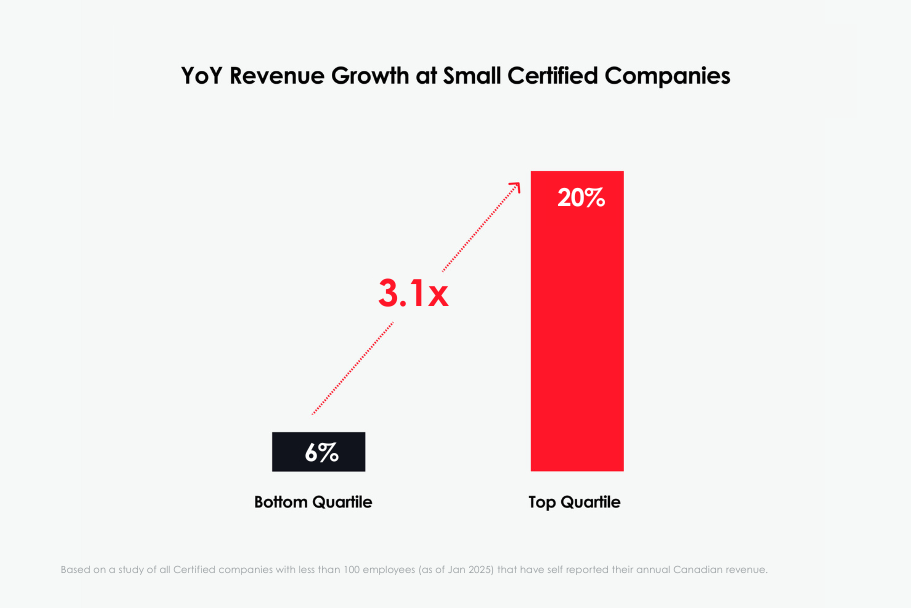
Among small businesses with fewer than 100 employees, top-quartile companies grew revenue at 3.1 times the rate of their bottom-quartile counterparts — 20% year-over-year versus just 6%.
Among medium-sized businesses with 100 to 499 employees, the top quartile grew at 2.5 times the rate — 19% compared to 7%.
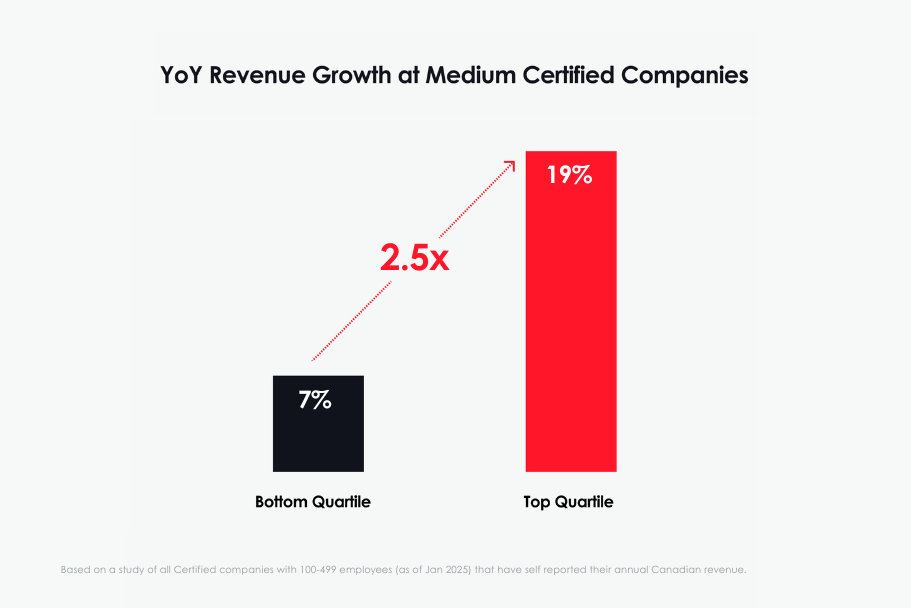
These findings are drawn from a study of Great Place To Work Certified™ companies that self-reported their annual Canadian revenue, as of January 2025.
Why Leadership Hits Differently at Smaller Companies
The size of a business changes the stakes of leadership in ways that aren't always obvious. In a large organisation, there are layers of management, established processes, and institutional structures that can absorb the impact — good or bad — of any single leader. At a smaller company, that cushion doesn't exist.
A strong leader at a 50-person company can shift direction overnight, bring a team together around a difficult goal, or reignite motivation at a critical moment. A poor one can do equal damage in the opposite direction.
"There are fewer buffers between top leadership and people on the front line," says Krittika Deshwal, principal business data analyst at Great Place To Work. "As a result, leadership scores on surveys have a stronger correlation to business performance."
For smaller businesses competing in tight markets, that correlation isn't just interesting — it's a strategic reality worth building around.
What High-Trust Leadership Actually Produces
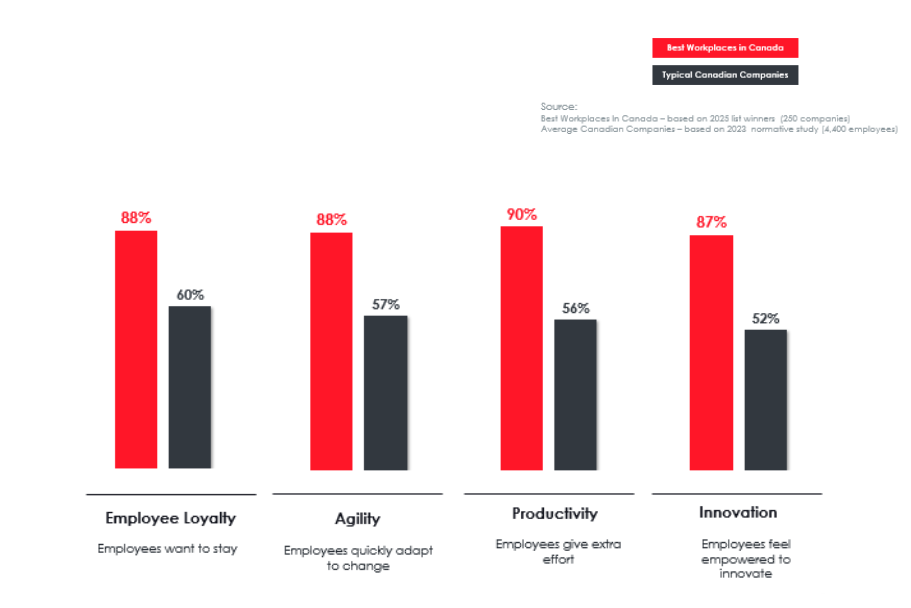
The revenue data tells one part of the story. The broader picture, captured in our research on the Great Place To Work Effect, is equally telling.
At Best Workplaces in Canada™, 90% of employees say they go above and beyond in their roles — compared to 56% at typical Canadian organisations. Nearly nine in ten employees at top-ranked workplaces want to stay with their employer, versus six in ten elsewhere. And when conditions change, employees at high-trust organisations are far more likely to adapt quickly: 88% say their teams respond well to change, compared to 57% at average companies.
The pattern holds across every major business outcome — customer service, innovation, productivity, and teamwork — with Best Workplaces in Canada consistently outperforming by significant margins.
The thread connecting all of it is employee confidence in leadership. When that confidence is high, people bring more of themselves to their work. When it's low, they don't.
"Because our model is interconnected, measuring confidence in leadership gives us a clear signal on performance across the organisation," Deshwal explains. "Using odds ratios, we can see how leadership drives a range of important outcomes."
The companies at the top of the revenue growth curve didn't get there by accident. Sustained, deliberate investment in building leadership quality is what separates them from their peers.
"Companies that intentionally invest in leadership are growing their revenue much faster than their peers, which means measuring leadership effectiveness is key for survival as a small or medium business."
Practical Steps Leaders Can Take Right Now
Knowing that leadership drives growth is one thing. Knowing where to start is another.
The foundation, according to Julian Lute, insights and innovation strategist at Great Place To Work, is visibility and genuine connection. In smaller organisations, employees form direct impressions of leadership through daily interactions — and those impressions carry real weight.
"Employees in small companies watch leaders closely and are constantly assessing their direct relationship with decision-makers," Lute says. "If you feel your leaders are approachable, friendly, and invested in your success, that makes an even bigger difference in those workplaces built on personal relationships."
That visibility needs to be backed by real investment in developing leaders — not just holding them to performance targets. "Onboard leaders with clear expectations and give them regular space to practise leadership, not just chase goals," Lute advises.
Accountability culture is another area where small-company leaders can build or erode trust quickly. Lute's recommendation is simple: go first. When leaders openly acknowledge their own missteps, it creates psychological safety for everyone else to do the same.
"On smaller teams, wins naturally feel collective, but losses often get assigned to one person," he says. "That dynamic kills trust and discourages people from taking risks."
Finally, resist the urge to overhaul everything at once. The instinct to fix multiple problems simultaneously is understandable — especially in resource-constrained environments — but cultural change requires focus and follow-through.
"Pick one behaviour to improve right away, such as clarifying decisions, slowing down to listen, or closing communication loops," Lute recommends. "Tell your team what you are working on and show the change in action."
Progress on a single, visible behaviour builds credibility. And credibility, over time, builds trust.
This article is an adaptation of the original Great Place To Work®, written by Ted Kitterman, Content Manager.
Feedback
We value your feedback! Your insights are crucial to helping us create meaningful content. Are there specific challenges you'd like us to address? Share your suggestions or ideas with us. Together, we can develop resources that truly make a difference. Have feedback? Fill out this form by clicking here.