



AI - Artificial Intelligence, Benchmarks & Trends, Employee Burnout, Psychological Safety, Training & Development
Key Takeaways:
- AI adoption: HR teams need clear visibility into how AI affects roles, workflows, and employee expectations as use expands across the workplace.
- AI metrics: Measuring success through efficiency, decision-making, employee experience, and business results keeps AI efforts grounded in purpose.
- Psychological safety: Trust and transparency help employees ask questions, test new tools, and adapt to change with more confidence.
- Burnout prevention: Sustainable performance depends on better workload design, role clarity, and enough recovery time as change accelerates.
- Skills development: Training delivers more value when employees can apply new skills in daily work and connect growth to career progress.
Great Voices — AI Blog Summary 
*This is an AI-generated audio discussion of the blog article.
In 2026, Canadian HR leaders will prioritize AI adoption, psychological safety, burnout prevention, and continuous skills development to balance innovation with employee trust and well-being. These priorities reflect the growing need to measure AI’s impact, support employees through rapid change, and create sustainable workplaces in an evolving digital landscape.
1. Assess AI’s impact on HR operations and workforce expectations
One of HR’s most immediate responsibilities is to understand how AI will affect its own function. From recruitment and onboarding to learning and workforce planning, HR teams need clarity on where AI is being introduced and what impact it will have on roles, responsibilities, and decision-making.
This work requires close collaboration with technology and IT teams to ensure AI tools are aligned with operational needs and implemented responsibly. Just as important, HR must help employees understand how AI will be used and what it means for their work.
That need is already visible in Canada. According to KPMG Canada, more than half of Canadian employees report using generative AI at work, yet 83% say they need more training or guidance to use it effectively. This gap highlights HR’s role in setting expectations, providing education, and building trust before uncertainty undermines engagement.
2. Establish clear metrics to measure AI impact in HR
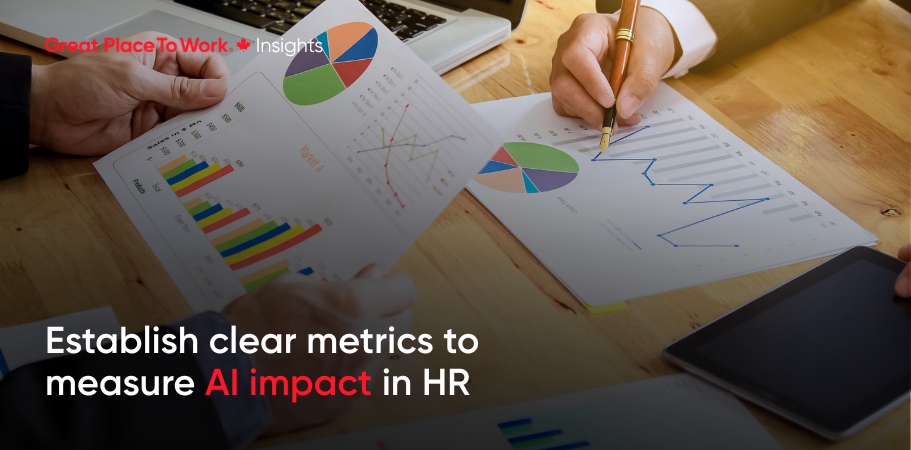
Interest in AI adoption continues to grow, but progress has been uneven. Without clear success measures, organizations risk investing in tools that deliver limited value.
Canadian data reflects this challenge. A recent Statistics Canada report indicate that only 12.2% of Canadian businesses were using AI in their operations as of mid-2025, despite rising awareness and experimentation. Most organizations remain in early or pilot stages, underscoring the gap between ambition and measurable outcomes.
For HR leaders, this makes it critical to define how AI success will be evaluated whether through improved efficiency, better decision-making, enhanced employee experience, or stronger business results. Clear metrics help ensure AI initiatives are grounded in purpose rather than experimentation alone.
Beyond efficiency, the long-term value of AI lies in how time savings are reinvested. When automation allows employees to focus on higher-value work, organizations are better positioned to improve outcomes for customers and employees alike.
3. Strengthen psychological safety to support AI adoption
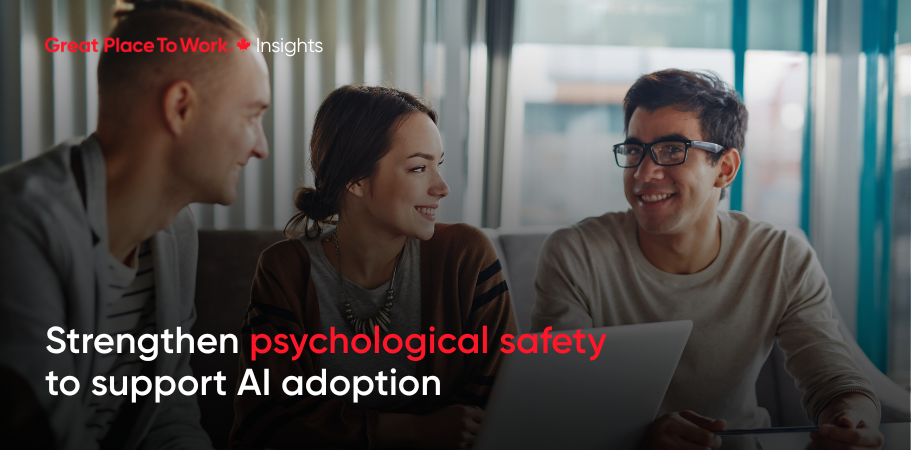
AI adoption is not only a technical challenge—it is a human one. Employees are more likely to engage with new tools when they trust leadership and feel safe asking questions, experimenting, and learning.
Psychological safety plays a key role in this process. If employees fear that mistakes made while learning AI tools will be penalized, or that AI is being introduced without transparency, resistance is likely to follow.
Psychological safety remains a significant concern in Canadian workplaces. Statistics Canada reports that one in four employed Canadians experiences high levels of work-related stress, underscoring the importance of trust, support, and psychological safety as organizations introduce new technologies and new ways of working.
HR leaders who prioritize trust, communication, and inclusion create the conditions needed for AI adoption to succeed by addressing both skill gaps and emotional barriers.
4. Address burnout risks tied to rapid technological change
The pace of change driven by AI is increasing pressure on employees and leaders alike. New tools can accelerate workflows, compress timelines, and reshape roles more quickly than traditional change cycles allow.
Canadian workforce data already signals strain. The Mental Health Research Canada report shows that 39% of Canadian employees feel burned out, an increase from previous years. At the same time, 46% of Canadian workers worry their job could be replaced by someone who is more proficient with generative AI, according to KPMG Canada's recent research.
As organizations adopt AI more quickly, HR leaders will need to pay close attention to workload design, role clarity, and recovery time. Supporting sustainable performance, rather than constant intensity, will be essential to maintaining engagement and reducing turnover risk.
5. Reinvest in employee training and skills development

Investment in learning and development remains one of the most effective responses to disruption. As AI reshapes work, organizations that help employees build relevant skills are better positioned to adapt.
Canadian employers are beginning to respond. Among businesses already using AI, 38.9% report training current employees to work with AI, and 40.1% are redesigning workflows to support new technologies (Statistics Canada, 2025).
For training to be effective, it must focus on building real capability, not just tracking course completion. Employees want clarity on which skills matter, how quickly they are expected to develop them, and how growth will be recognized.
Learning is also most effective when it is embedded in daily work. Opportunities to apply new skills, receive feedback, and connect development to career progression help reinforce confidence and adaptability as roles continue to evolve.
Looking ahead
As AI becomes a permanent feature of the workplace, HR’s role continues to expand. Success in 2026 will depend less on how quickly organizations adopt new tools and more on how thoughtfully they support people through change.
By focusing on trust, measurement, psychological safety, sustainable performance, and meaningful development, HR leaders can help ensure AI strengthens the employee experience rather than undermining it.
This article is an adaptation of the original Great Place To Work®, written by Ted Kitterman, Content Manager.
Tools & Resources
- Great Place To Work® Certification: A recognized benchmark of workplace trust that helps organizations understand employee experience and identify where leadership, culture, and people practices need focused attention.
- Trust Index™ Employee Feedback Survey: An evidence-based employee survey that measures trust, leadership credibility, respect, fairness, and pride—providing data to guide decisions during AI adoption and organizational change.
- Culture Consulting: Expert support to help organizations translate employee feedback into practical actions, strengthen leadership practices, and address issues such as burnout, trust, and change readiness.
- Leadership Development: Programs designed to build manager and leadership capability, supporting psychological safety, effective change management, and sustainable performance in evolving Canadian workplaces.
Feedback
We value your feedback! Your insights are crucial to helping us create meaningful content. Did the perspectives in this article spark new ways to approach AI adoption, psychological safety, or workforce readiness in your organization? Are there specific challenges you'd like us to address? Share your suggestions or ideas with us. Together, we can develop resources that truly make a difference. Have feedback? Fill out this form by clicking here.
Get Certified
Want to understand how your people experience change, leadership, and trust as new technologies reshape work? Get Certified today and learn the answer to this question and gain many more insights along the way.
Frequently Asked Questions:
What are the main HR priorities shaping Canadian workplaces in 2026?
The strongest priorities are assessing AI’s impact on work, setting clear success metrics, strengthening psychological safety, reducing burnout risk, and investing in practical skills development.
Why does psychological safety matter when introducing AI at work?
Psychological safety gives employees the confidence to ask questions, try new tools, and learn without fear, which makes change easier to adopt and more effective over time.
How should HR measure the impact of AI?
Useful measures include efficiency gains, better decision-making, employee experience, and business outcomes, along with how saved time is redirected into higher-value work.
How can organizations support employees as jobs continue to evolve?
The most effective approach is to pair training with workflow redesign, real practice, feedback, and clear guidance on which skills matter and how growth will be recognized.