



AI - Artificial Intelligence, Company Culture, Employee Engagement , Employee Experience, Purpose, Talent Acquisition
Key Takeaways:
- Meaningful work is the top retention driver for Gen Z, who are 3.6x more likely to stay when their work feels meaningful, yet only 74% say it does, versus 90% of Boomers.
- Gen Z in the workplace reports lower trust than older generations even at Certified organisations, and the retention gap is widening rather than closing.
- Employee retention is under pressure in Canada, where one in three Gen Z workers plan to leave within a year and 41% of leavers cite poor workplace culture.
- Gen Z work ethic myths fall apart in the data: promotions rank only 10th as an effort driver, while dependable colleagues make Gen Z 6.3x more likely to give extra effort.
- Mentorship program investments and cross-generational working groups rebuild the connection to purpose that AI-heavy workflows are eroding.
- Employee motivation dropped 11% and boredom rose 20% in studies where employees relied on AI to complete their work.
A high-trust workplace lifts every generation, yet the youngest employees keep trailing their older colleagues on the outcomes that matter most.
When employees trust their leaders and their colleagues, good things follow: people adapt to change more quickly, give extra effort, and choose to stay. This is the Great Place To Work Effect, where trust powers the culture drivers behind stronger business performance.
Yet the benefits are not spread evenly across generations. Gen Z employees consistently report lower trust than their older colleagues, even inside Great Place To Work® Certified™ organisations. And when trust runs low, for Gen Z and Boomers alike, turnover tends to run high.
Why Meaningful Work Matters More Than Trust Alone
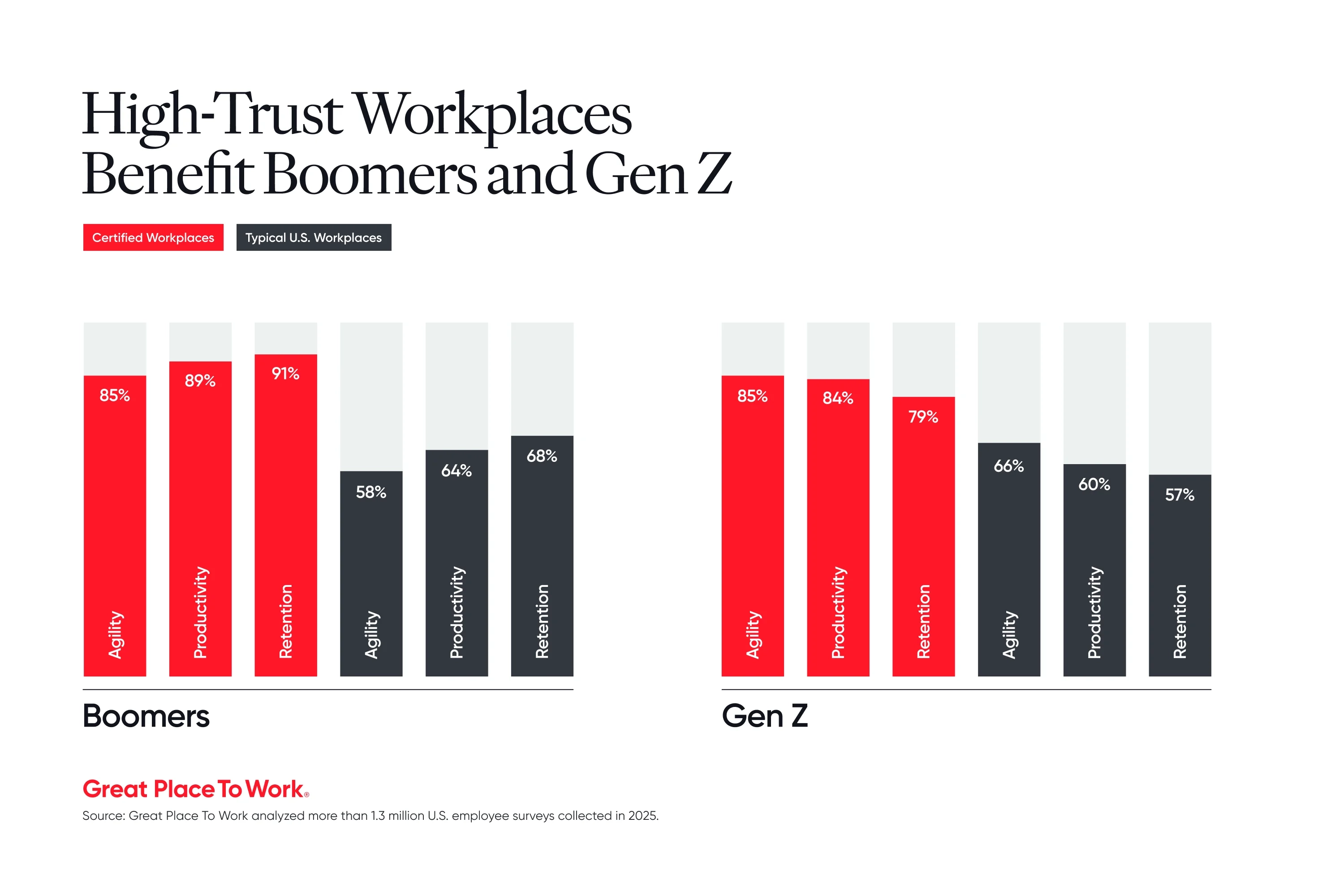
Something curious shows up in the data on Gen Z and retention. On agility and productivity, the gap between Boomers and Gen Z either disappears or stays within five points at high-trust organisations. On the desire to stay, the gap does not shrink at all; it actually widens by a point. Even with every advantage a high-trust environment offers, Gen Z is not catching up.
The underlying cause is how each generation experiences meaningful work, or the lack of it. Purpose at work is the strongest driver of retention for both generations, but Gen Z is far less likely to describe their work as meaningful. At Certified organisations, 90% of Boomers say their work carries special meaning. Among Gen Z, that figure falls to 74%, a 16-point gap.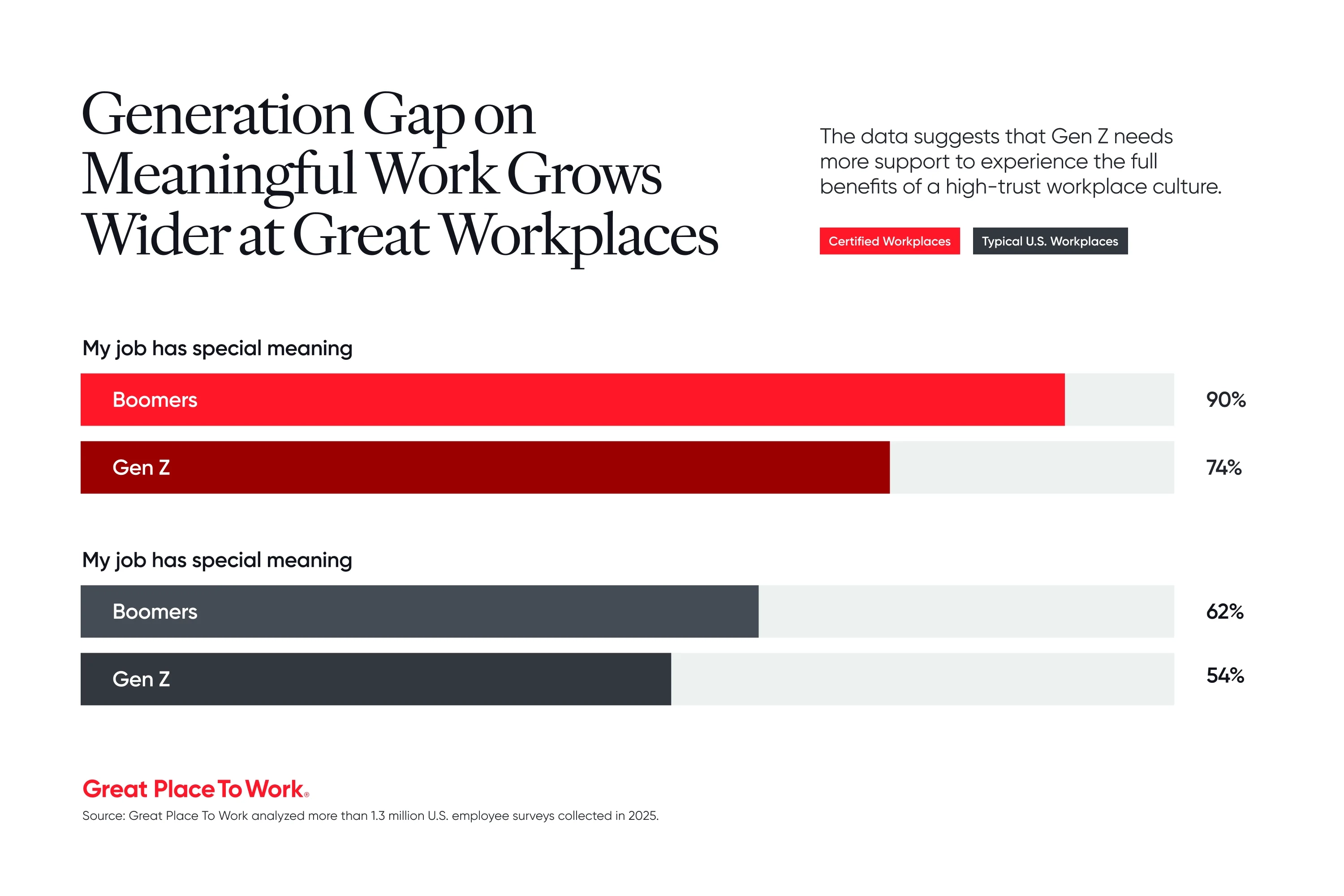
Gallup research points in the same direction: since 2020, fewer Gen Z workers report feeling cared for at work (down 13 points) or believing their job is important (down nine points).
Artificial intelligence may be part of the story, and it is already visible in employment data for younger workers. In a series of studies at Zhejiang University, intrinsic motivation fell 11% on average and boredom climbed 20% when employees leaned on AI to complete their work. University of Pennsylvania researchers found that when employees used AI to draft their personal goals, psychological ownership collapsed and follow-through dropped from 73% to 47%.
Gen Z in the Workplace: The Canadian Picture
Canadian employers are feeling this shift directly. According to Randstad Canada’s Gen Z report, one in three Gen Z workers plan to leave their current role within a year, and 22% have already left a job in the past 12 months, the highest attrition of any generation. Average tenure in the first five years of a career sits at just 1.1 years, compared with 2.9 years for Boomers.
Notably, pay is not the whole story. Among Canadian Gen Z workers who left a role within a year, 41% pointed to poor workplace culture and 34% to a lack of progression opportunities. For organisations serious about employee retention, culture is not a nice-to-have; it is the retention strategy.
The Truth About the Gen Z Work Ethic
The popular narrative says younger workers want to skip the hard work and jump straight to a promotion. The data tells a different story about the Gen Z work ethic.
Promotions rank only 10th among the drivers of extra effort for Gen Z. Cooperation matters far more: Gen Z employees who can count on their colleagues are 6.3 times more likely to give extra effort. And when it comes to staying, meaningful work is the top driver of retention for Gen Z (3.6 times more likely to want to stay), followed by psychological safety (1.7 times) and confidence in leadership (1.6 times).
4 Ways to Strengthen Employee Retention and Motivation
What can organisations do to close the purpose gap and lift employee motivation across generations? Four practical starting points:
- Listen to Gen Z directly: Run focus groups where employees can speak candidly without managers in the room, and use your survey data to pinpoint where the Gen Z experience diverges from the rest of the organisation.
- Ask how AI tools are landing across cohorts: Your leadership team’s experience with AI will look very different from that of junior staff or frontline employees. Get curious before assuming.
- Invest in a mentorship program: Rethink how training is delivered and intentionally build cross-generational working groups. An employee resource group focused on mentorship across generations is well worth considering.
- Act before the attrition data does: Quit rates are a lagging indicator. By the time an employee resigns, the damage is done. Look for experience gaps proactively and address what you find.
Gen Z is not asking for less work; they are asking for meaningful work. Organisations that connect their youngest employees to purpose, and back it up with cooperation and trustworthy leadership, will win the retention battle. Start by listening to your people and measuring the Great Place To Work Effect in your own organisation.
This article is an adaptation of the original Great Place To Work®, written by Ted Kitterman, Content Manager, Great Place To Work US.
Feedback
Your feedback matters to us! Let us know how we can improve our content and better support your workplace culture journey. Have feedback? Fill out this form by clicking here.
Ready to earn Great Place To Work Certification™?
Start your journey today and showcase your culture to the world.
People Also Asked
What does Gen Z value most in a workplace?
Purpose, cooperation, and psychological safety top the list. Gen Z stays where work feels meaningful, colleagues are dependable, and leadership earns their confidence.
Why is Gen Z turnover so high?
Beyond pay, the biggest drivers are poor workplace culture (41%) and a lack of progression opportunities (34%), reflecting unmet ambition rather than disloyalty.
How do you build trust with Gen Z employees?
Listen to them directly without managers in the room, act on survey feedback before attrition shows up in the data, and give them visible paths to grow.
Are mentorship programs effective for retaining young employees?
Yes. Cross-generational mentorship strengthens the cooperation and connection that drive Gen Z effort and retention, and employee resource groups are a practical way to structure it.
Do high-trust workplaces benefit every generation?
Yes. High-trust workplaces lift agility, effort, and retention across all generations, though Gen Z still needs targeted support to close the purpose gap.
Frequently Asked Questions:
Why is meaningful work important for Gen Z retention?
Meaningful work is the single strongest driver of retention for Gen Z: employees who find their work meaningful are 3.6 times more likely to want to stay, ahead of psychological safety (1.7x) and confidence in leadership (1.6x).
What motivates Gen Z employees to give extra effort?
Cooperation. Gen Z workers who can count on their colleagues are 6.3 times more likely to give extra effort, while promotions rank only 10th among effort drivers.
How can employers help Gen Z connect to purpose at work?
Hold manager-free focus groups, use employee survey data to find generational gaps, build cross-generational mentorship programs, and check how AI tools are affecting junior and frontline roles.
How does AI use affect Gen Z's sense of purpose?
Research shows intrinsic motivation fell 11% and boredom rose 20% when employees used AI to complete work, and goal follow-through dropped from 73% to 47% when AI wrote personal goals.
How long do Gen Z employees stay in a job in Canada?
Average tenure during the first five years of a Gen Z career is 1.1 years, compared with 2.9 years for Boomers, and one in three plan to leave their current role within a year.