




Employee Wellbeing, Employee Experience, Purpose, Retention Strategy
Key Takeaways:
- Meaningful work: Employees who see clear purpose in their work are far more likely to stay, making purpose one of the strongest retention drivers.
- Psychological and emotional health: A healthy work environment strengthens retention by supporting employees in ways that influence their day-to-day experience.
- Fair treatment: Feeling respected and treated as a full member of the team has a strong impact on whether people want to remain with an organization.
- Employee experience: Retention is shaped less by compensation alone and more by how consistently people feel valued, supported, and connected at work.
- Turnover costs: Improving workplace experience can protect performance and reduce the significant financial cost tied to employee turnover.
Insights from more than 1.3 million employee surveys reveal a consistent pattern in what influences people’s decisions to stay with their employer.
What influences employees to stay?
Compensation and benefits remain important. However, they are rarely the factors that distinguish high-performing workplaces from others.
Across Great Place To Work® Certified™ organizations, where employees consistently report positive workplace experiences, the strongest predictor of retention is whether people find their work meaningful.
When employees say their work has a clear purpose or personal significance, they are nearly four times more likely to report an intention to stay with their organization (Great Place To Work® 2021 Global Employee Engagement Study). This relationship is more than twice as strong as the link between retention and either fair pay or access to distinctive benefits.
The workplace experiences that matter most for retention
In high-trust workplaces, pay and benefits do not rank among the top drivers of retention. Employees who believe they are paid fairly are 54% more likely to want to stay, while those who report access to special or unique benefits are 74% more likely to remain.
By comparison, three experience-based factors stand out as the most influential drivers of retention, regardless of role:
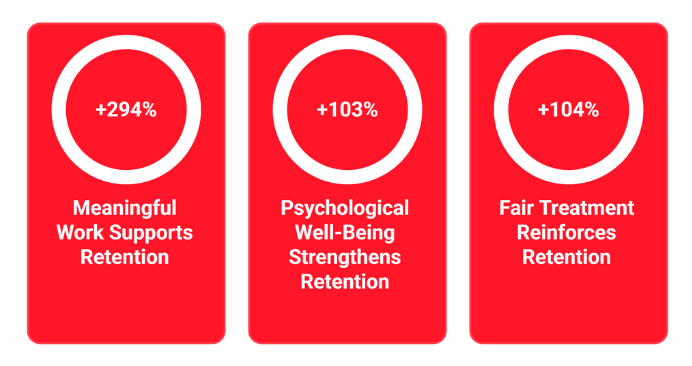
- Employees who feel their work is meaningful are 294% more likely to want to stay
- Employees who describe their workplace as psychologically and emotionally healthy are 103% more likely to stay
- Employees who feel respected and treated as full members of the team are 104% more likely to remain
Together, these findings suggest that retention is shaped less by compensation strategies and more by how people experience their work on a day-to-day basis.
Differences in retention drivers across genders
An analysis of more than 1.3 million employee surveys collected in 2024 and 2025 also highlights differences in how retention drivers are experienced by men and women.
Meaningful work is the strongest retention factor for both groups. However, psychological and emotional health plays a particularly significant role for women. Women who report working in psychologically and emotionally healthy environments are 123% more likely to want to stay, compared to 87% more likely among men.
Despite these differences in magnitude, the same core experiences influence retention across genders. This suggests that efforts to strengthen purpose, well-being, and fairness are likely to improve retention outcomes for the entire workforce.
Why retention is shaped by everyday experiences

The decision to stay or leave rarely comes down to a single moment. Instead, it builds over time through everyday experiences at work.
In Canada, the cost of replacing an employee can range from approximately 75% to 200% of their annual salary, depending on the role and industry. Recent estimates place average turnover costs at around $29,000 per employee, with a notable share of Canadian employers reporting annual turnover expenses exceeding $100,000 (Express Employment Professionals Canada).
At the same time, burnout is becoming increasingly common. Nearly 39% of Canadian employees report experiencing burnout, which is associated with reduced productivity, higher absenteeism, and a greater likelihood of turnover. Even without precise estimates for how long it takes new hires to reach full productivity, these trends point to meaningful performance and continuity losses when employees disengage or leave (Mental Health Commission of Canada).
At a national level, the impact is significant. Across Canada, the combined effects of mental health challenges in the workplace—including turnover, absenteeism, and presenteeism—are estimated to exceed $50 billion annually. This reinforces the close connection between employee well-being, engagement, and retention.
Recent Canadian benchmarks help organizations estimate the potential scale of turnover costs. With an average turnover rate of 10.2% and estimated replacement costs of $29,234 per employee, a company with 1,000 employees could face nearly $3 million in annual turnover-related costs, with costs rising even higher for more highly paid or specialized roles.
Conclusion
Employee retention is not primarily a compensation challenge. While pay and benefits play an important role, they do not consistently distinguish organizations where people choose to stay.
The strongest drivers of retention are rooted in experience. Employees are more likely to remain with organizations where their work feels meaningful, where their psychological and emotional well-being is supported, and where they are treated with fairness and respect. These conditions are created through everyday leadership behaviours, workplace norms, and organizational culture—not through one-time incentives.
As organizations across Canada navigate ongoing economic uncertainty and labour market shifts, retention is best understood as an outcome of the employee experience. When people consistently feel valued, supported, and connected to purpose, they are far more likely to stay—and to contribute at their best.
This article is an adaptation of the original Great Place To Work®, written by Ted Kitterman, Content Manager.
Tools & Resources
- Great Place To Work® Certification: Provides a research-backed way to validate employee experience, strengthen workplace culture, and improve retention by demonstrating trust, fairness, and meaningful work to current and prospective employees.
- Trust Index™ Employee Feedback Survey: Captures employee perceptions of purpose, well-being, and fairness—key drivers of retention—while offering benchmark data to identify strengths and gaps in the day-to-day workplace experience.
- Employee Well-being: Offers research and tools to understand how psychological and emotional well-being influences retention, helping organizations address burnout and create healthier, more sustainable work environments.
- Employee Engagement: Helps organizations measure and understand engagement drivers tied to retention, including pride, respect, fairness, and credibility, enabling data-informed decisions to improve employee experience.
Feedback
We value your feedback! Your insights are crucial to helping us create meaningful content. Did the insights in this article spark new ways to strengthen employee retention in your organization? Are there specific challenges you'd like us to address? Share your suggestions or ideas with us. Together, we can develop resources that truly make a difference. Have feedback? Fill out this form by clicking here.
Get Certified
Want to understand what’s really driving employee retention in your organization? Get Certified today and learn the answer to this question and gain many more insights along the way.
Frequently Asked Questions:
What workplace experiences have the strongest impact on employee retention?
The strongest drivers are meaningful work, psychological and emotional well-being, and being treated with respect and fairness as a full member of the team.
How does meaningful work influence retention?
When employees feel their work has clear purpose or personal significance, they are much more likely to want to stay with their employer over time.
How does well-being support stronger retention outcomes?
Psychological and emotional health helps employees feel more stable, supported, and engaged, which increases their intent to stay.
Why does fair treatment matter for retention?
When people feel respected regardless of role and included as full members of the team, they are more likely to remain committed to the organization.
How can retention improvements affect business performance?
Stronger retention helps reduce turnover-related costs, protect continuity, and support productivity by keeping experienced employees engaged and in place.