
AI - Artificial Intelligence, Benchmarks & Trends, Company Culture, Training & Development
Key Takeaways:
- AI strategy succeeds when the culture is ready first, because trust, clear direction and pride are what make people willing to adopt new tools.
- Organizational culture shows up in the results at Experian, where 89% of employees are proud to work there and 90% say its AI tools help them do their jobs better.
- AI governance builds confidence rather than slowing progress, and cybersecurity or privacy concerns are the barrier Canadian businesses cite most often when limiting AI use.
- Upskilling works best when it reaches every function, and employees who feel well trained are 20% more inclined to embrace AI adoption.
- Continuous learning turns uncertainty into enthusiasm, with 77% of Experian employees in Europe excited about what AI can bring to their work.
- AI enablement is accelerating in Canada, where the share of businesses using AI tripled from 6.1% to 19.2% between 2024 and 2026.
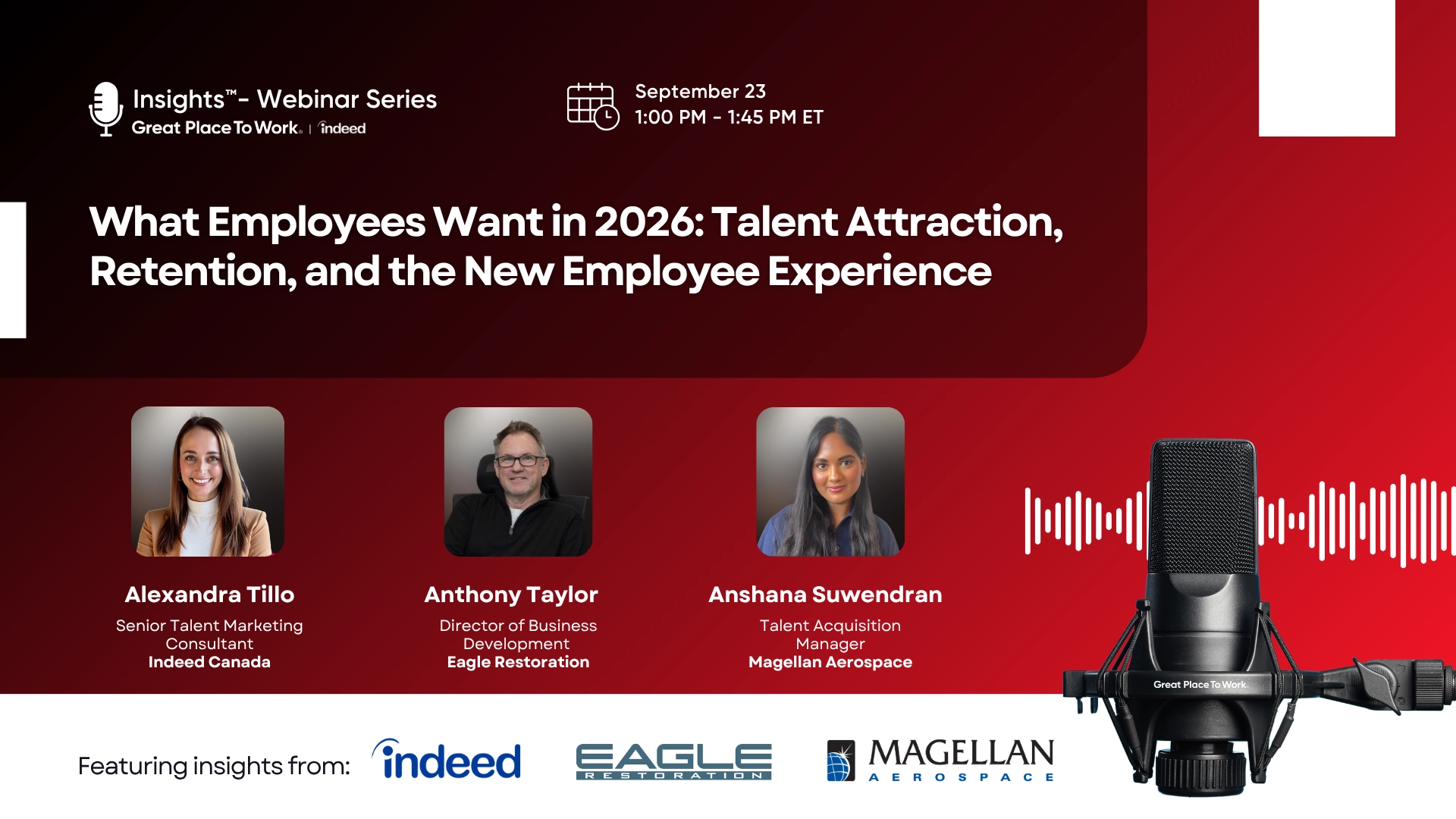
Great Voices — AI Blog Summary 🎙
This is an AI-generated audio discussion of the blog article.
Canadian businesses have tripled their use of AI in two years, yet technology alone rarely decides whether adoption succeeds. Experian shows what does: a high-trust culture built before the rollout, with governance, upskilling and continuous learning that reach every role. Here’s what Canadian leaders can take from its approach, backed by data from The Trust Dividend.
AI is moving out of pilot projects and into everyday work at Canadian organizations. In the second quarter of 2026, 19.2% of Canadian businesses reported using AI to produce goods or deliver services over the previous 12 months, triple the share recorded two years earlier, according to Statistics Canada. By the third quarter, one in four businesses (25.2%) said they planned to use AI over the next year, up from 14.5% a year before.
For leaders, the harder question is no longer whether to adopt AI. It is how to move quickly on an AI strategy without leaving people behind.
At Experian, the answer starts with trust.
The global data and technology company employs more than 25,000 people across 33 countries and is Great Place To Work Certified™ in Canada. Well before AI transformation became a priority, Experian had already built a high-trust culture grounded in effective leadership, continuous learning and development, and innovation that includes everyone. That foundation is why its workforce is now embracing AI at scale while the business keeps delivering strong financial results.
Experian reported revenue of US$8.445 billion in its most recent fiscal year as it expanded AI across its products, platforms and operations. When Great Place To Work® surveyed Experian employees in 14 European countries, nine in 10 said they are encouraged to use AI in their work and agreed that the company gives them AI tools that help them do their jobs better. More than eight in 10 (83%) said they trust Experian to use AI fairly and ethically.
CEO Brian Cassin describes artificial intelligence as “becoming a core driver of how we operate and grow.” He points to productivity gains of roughly 10% to 15%, with some areas exceeding 30%. The company has also identified more than US$15 billion in AI-enabled market opportunities, spanning health, agentic commerce, expansion of its Ascend platform and embedded consumer marketplaces.
Organizational Culture Comes Before the Technology
89% of Experian employees are proud to work there
Why should an AI strategy start with culture?
People adopt new tools when they trust their leaders, understand where the business is heading and feel proud of where they work. Experian built those conditions before its AI transformation.
Experian did not treat AI as a technology deployment alone. For years, it has invested in the organizational culture that makes responsible AI adoption possible.
Pride runs high across the company: 89% of employees say they are proud to work there, and 90% agree that Experian provides AI tools that help them do their job better. Confidence in the business direction is just as strong. Eight in 10 agree that AI will create new growth opportunities for Experian, and 90% understand how their individual and team goals contribute to the company’s broader objectives. Together, those results describe a culture where employees can see a future for themselves as the business evolves.
The same pattern holds in Canada. The Trust Dividend, Great Place To Work Canada’s 2026 analysis of 117,696 employee responses at 375 Best Workplaces™ in Alberta, British Columbia, Ontario and Quebec, tracks ten “AI-ready trust signals”: workplace experiences that predict whether people will adopt new technology. Every one of them improved between 2025 and 2026. At these workplaces, 88% of employees say leaders have a clear view of the way forward, and 89% say people adapt quickly to change.
AI Governance: Innovation With Guardrails

Cybersecurity or privacy concerns are the top barrier to AI use for Canadian businesses
How does Experian balance AI innovation with governance?
Its AI strategy rests on a global governance framework, responsible AI principles, human oversight and a commitment to transparency, accountability and fairness, guided by the principle that innovation should strengthen trust.
The majority of Experian employees now use AI-powered tools, generating more than one million AI interactions every month. Leaders have been deliberate about balancing that momentum with AI governance, guided by a simple principle: innovation should strengthen trust, never undermine it.
Experian’s AI strategy is underpinned by a global governance framework, responsible AI principles, requirements for human oversight, and a commitment to transparency, accountability and fairness. These guardrails apply to customer-facing products and employee tools alike.
For Canadian employers, governance is often what unlocks adoption. Cybersecurity or privacy concerns were the barrier businesses cited most often as limiting their use of AI (13.4%), ahead of cost (10.6%), according to Statistics Canada. Clear principles about how AI is used, and where people remain accountable for decisions, speak directly to that concern.
Upskilling That Reaches Every Role
68.1% of larger Canadian businesses using AI train their existing employees
How does training affect AI adoption?
Employees who believe they receive adequate training and development are 20% more inclined to embrace AI adoption, which is why upskilling works best when it reaches every role.
Experian has invested heavily in upskilling through its MyCareer portal, which gives employees on-demand development support powered by AI.
What sets the approach apart is who it reaches. AI capability building is not limited to technical specialists; it is being opened up across every function. Leaders receive dedicated training through programs such as Leading with AI. The goal is not only to teach people how to use AI, but how to use it responsibly and effectively.
Canadian businesses are moving in the same direction. Among businesses that used AI over the previous 12 months, 44.4% changed their training or staffing practices as a result, and 32.0% provided AI-related training to existing employees. Among AI-using businesses with 100 or more employees, 68.1% trained existing employees and 51.7% trained executives, based on Statistics Canada data.
That investment matters. Great Place To Work’s Winning With AI research found that employees who believe they receive adequate training and development are 20% more inclined to embrace AI adoption. Yet training and development (84%) sits near the bottom of the ten AI-ready trust signals at the 2026 provincial Best Workplaces, which makes it one of the clearest opportunities for Canadian leaders.
Continuous Learning Builds Confidence, Not Anxiety
77% of Experian employees are excited about the benefits AI can bring to their work
What are AI-ready trust signals?
They are ten workplace experiences, measured through the Trust Index™ Survey, that predict whether people will adopt new technology. All ten rose at the 2026 provincial Best Workplaces™ in Canada.
Across all 14 European countries surveyed, 77% of Experian employees say they are excited about the benefits AI can bring to their work. They describe a culture built on AI enablement, career growth, flexibility, strong leadership and continuous learning, and many name the company’s investment in reskilling and professional development as a reason they consider Experian a great place to work.
That excitement is not a coincidence. When people see their employer investing in their growth, AI reads as an opportunity rather than a threat to their role. Canadian data points the same way: at the 2026 provincial Best Workplaces, employees who feel they have a voice in decisions that affect them are twice as likely to lean into change, and 91% say honest mistakes are treated as part of doing business. Room to experiment is what turns training into real adoption.
Why Technology Alone Cannot Power an AI Strategy
The Experian Way connects innovation, collaboration, accountability, inclusion and performance
What role do company values play in AI adoption?
Values give AI a clear purpose. When adoption is tied to the behaviours an organization already rewards, AI reinforces how people work rather than standing apart from it.
Technology alone does not create a competitive advantage. What truly drives performance, and what makes an AI strategy work, is culture.
At Experian, employees trust their leaders and understand where the company is going. They have meaningful opportunities to grow, and they believe innovation will create more of them. Those conditions did not appear by chance. They are reinforced by The Experian Way, a values framework that connects innovation, collaboration, accountability, inclusion and performance. The outcome is a culture that does more than support AI adoption: it accelerates it.
Putting Culture First: Where Canadian Leaders Can Start

Five places Canadian leaders can start building an AI strategy on trust
Where should Canadian leaders start with an AI strategy?
Measure trust before the rollout, pair every tool with clear governance, open AI learning to every role, connect AI to career growth and anchor adoption in your organization’s values.
- Measure trust before the rollout: Understand how employees experience leadership, clarity and pride before introducing new tools, so you know where adoption is likely to stall.
- Pair every tool with governance: Publish responsible AI principles, keep human oversight in place, and be transparent about how AI decisions are made.
- Open up upskilling to every role: Make AI learning available across functions, and give leaders dedicated training on guiding their teams through change.
- Connect AI to career growth: Show employees how AI creates opportunities for them, not only for the business.
- Anchor adoption in your values: Tie AI to the behaviours your organization already recognizes, so it becomes part of how work gets done rather than a separate initiative.
Every one of these steps starts with knowing how your people experience work today. The Trust Index™ Survey measures the experiences that shape AI readiness, from trust in leadership to access to development, and benchmarks your results against top Canadian workplaces. To see how that trust translates into performance, explore the Great Place To Work® Effect.
This article is an adaptation of the original Great Place To Work®, written by Shalagh Fredericks, Head of Content and Community, Great Place To Work U.K.
Is your culture ready for AI? Certification as a Great Place To Work® shows you how employees experience trust, leadership and development, so you can build an AI strategy your people will embrace.
 Certification
Tools & Resources
- Employee Survey: Measure trust, clarity and access to development before you roll out new AI tools, so you know where adoption is likely to stall.
- Culture Consulting: Turn your results into a plan that pairs AI governance, manager readiness and upskilling with the culture your people already value.
- The Trust Dividend: See the ten AI-ready trust signals and how the 2026 provincial Best Workplaces™ score on each one.
- Winning With AI: Explore how training, fairness and a voice in decisions shape whether employees embrace AI at work.
Feedback
Your feedback matters to us! We are always looking for ways to make our content more useful for Canadian leaders. Have feedback? Fill out this form by clicking here.
Get Certified 
AI adoption moves fastest where employees trust their leaders. Certification gives you validated feedback on how your people experience trust, development and change. Get Certified today and see how your culture compares with top Canadian workplaces.
People Also Asked
What is organizational culture?
Organizational culture is the shared set of values, behaviours and expectations that shapes how people work together. It shows up in how leaders communicate, how decisions are made and how employees are treated, and it largely determines whether people trust the organization enough to embrace change.
What is AI governance?
AI governance is the set of principles, policies and oversight that guides how an organization builds and uses AI. It typically covers responsible AI principles, human review of important decisions, data privacy and clear accountability, so innovation moves forward without eroding trust.
How does organizational culture affect AI adoption?
People adopt new technology when they trust their leaders, understand where the business is heading and feel safe to experiment. A high-trust culture turns AI from a perceived threat into an opportunity, which is why adoption tends to move faster where those conditions are already in place.
How can organizations upskill employees for AI?
Start by making AI learning available to every function, not only technical teams. Pair new tools with practical learning paths, give managers dedicated training on leading through change, and track who has access to development so no group is left behind.
How do leaders influence organizational culture?
Leaders shape culture through what they model, reward and communicate. Being transparent about change, inviting employees into decisions and treating honest mistakes as learning all signal what the organization truly values, and employees take their cues from those behaviours.
How can AI be used in the workplace?
Common uses include data analytics, text analysis, virtual agents and on-demand learning support. The most effective organizations introduce these tools with clear guidelines, training and human oversight, so employees understand how AI supports their work rather than replaces their judgment.
Frequently Asked Questions:
Why should an AI strategy start with culture?
People adopt new tools when they trust their leaders, understand where the business is heading and feel proud of where they work. Experian built those conditions before its AI transformation, and today nine in 10 surveyed employees say they are encouraged to use AI in their work.
How does Experian balance AI innovation with governance?
Its AI strategy rests on a global governance framework, responsible AI principles, human oversight requirements and a commitment to transparency, accountability and fairness. Those guardrails apply to customer-facing products and employee tools alike, guided by the principle that innovation should strengthen trust.
How many Canadian businesses use AI today?
In the second quarter of 2026, 19.2% of Canadian businesses used AI to produce goods or deliver services over the previous 12 months, triple the 6.1% recorded in 2024. By the third quarter, 25.2% planned to use AI over the following year.
What are AI-ready trust signals?
They are ten workplace experiences, measured through the Trust Index™ Survey, that predict whether people will adopt new technology, such as being trusted without micromanagement, adapting quickly to change and being offered training. All ten rose at the 2026 provincial Best Workplaces™ in Canada.
What role do company values play in AI adoption?
Values give AI a clear purpose inside the organization. At Experian, The Experian Way connects innovation, collaboration, accountability, inclusion and performance, so AI adoption reinforces how people already work rather than standing apart from it.
How does training affect AI adoption?
Employees who believe they receive adequate training and development are 20% more inclined to embrace AI adoption. Among Canadian businesses using AI, 32.0% provide AI-related training to existing employees, rising to 68.1% among those with 100 or more employees.