

Key Takeaways:
- AI use is outpacing trust: about 57% of Canadians use AI regularly at work, yet only 29% trust it to positively influence the Canadian economy.
- The strain of AI is uneven, with almost 50% of mid-level managers and individual contributors reporting it compared with about 30% of executives.
- Involving employees in choosing and shaping AI tools was the top answer (44%) when attendees were asked what their organization most needs to do to build confidence around AI.
- Leaders build more credibility by admitting what they don't yet know about AI's impact on jobs than by offering reassurances they may later have to walk back.
- Trust in AI messaging depends on proximity: 67% of Canadians trust their immediate coworkers, while only 52% trust their CEO or most senior leaders.
AI in the Workplace: How HR Leaders Can Build Trust Through Change
AI in the workplace has become part of everyday routine, but employee confidence has not kept pace. Proof Strategies’ annual trust research shows about 57% of Canadians use AI regularly at work, yet only 29% trust that AI will positively influence the Canadian economy. For HR leaders, how AI is introduced can build confidence or create anxiety.
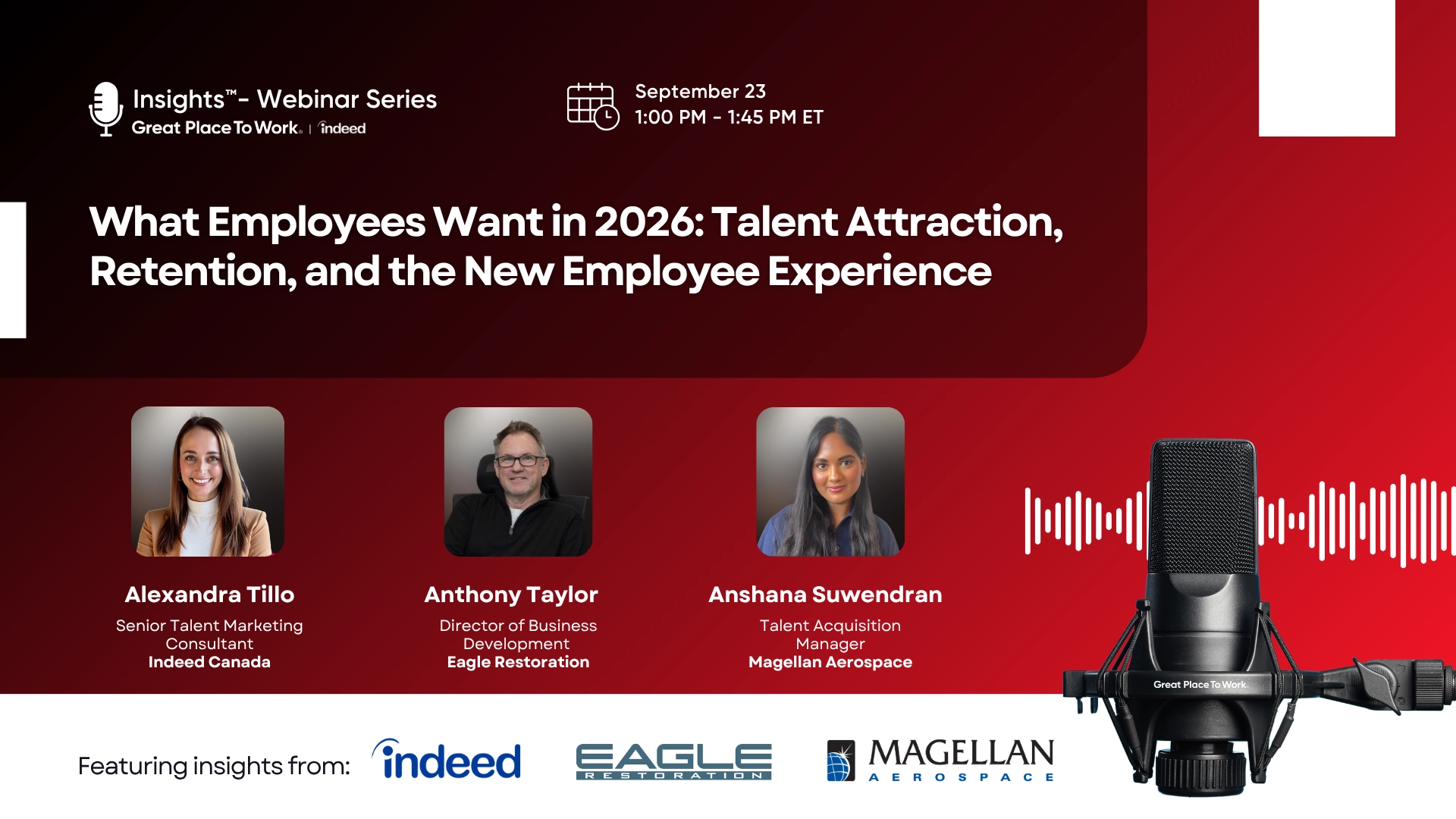
Great Place To Work® Canada brought together Alexandra Tillo, Senior Talent Marketing Consultant at Indeed Canada; Ally MacLellan, Head of AI Innovation & Technology at Proof Strategies Canada; and Mark Bystrek, People & Culture Lead Link at ET Group, with host Anne Cesak, CHRL, Senior Consultant at Great Place To Work® Canada. Their message was consistent: trust in AI is built by leaders, not by tools.
Why Adoption Is Not the Same as Trust
As Ally MacLellan explained, “adoption isn’t the same thing as confidence or trust.” Employees may use AI daily, sometimes reluctantly, with their concerns unresolved. With most new technology, trust grows with use. With AI, she noted, the opposite is happening.
In a live poll, 60% of attendees said their employees are “curious but cautious” about AI.
Indeed research shared by Alexandra Tillo shows how unevenly AI is felt. While 80% of Canadians say AI improves their productivity, almost 50% of mid-level managers and individual contributors report strain from it, compared with about 30% of executives.
Addressing Job Security Without False Certainty
Tillo observed that the worry is often less about AI itself than the instability around it. When employees see colleagues let go, even in another department, they stop feeling safe.
Her advice: leaders should stop trying to answer questions they cannot yet answer, because pretending otherwise works against trust. Saying “I don’t know yet” builds more credibility than a reassurance that later has to be walked back.
Leaders can still commit to growth. Indeed’s data shows 82% of employers expect the skills they look for to change completely within three to five years, and 67% of workers expect to need reskilling or upskilling. Among Canadian tech companies, 55% of high performers offer upskilling, compared with only 35% of those performing below expectations.
Introduce AI With Employees, Not To Them
MacLellan cautioned that AI is not a standard software rollout with a training session and a help guide. It is a new way of working.
She starts with the tasks people find most frustrating, such as time entry, then adds AI to workflows employees already know. At Proof Strategies, AI now runs a checklist on each press release before it goes live. The creative writing stays with the team, one review round is gone, and the step is standard practice across the agency.
Attendees agreed. Asked what their organization most needs to do to build employee confidence around AI, 44% chose involving employees in choosing and shaping AI tools, with reskilling next. Explaining the why behind each tool matters too, or employees may see AI as a threat.
Closing the Trust Gap Between Leaders and Teams
Proximity shapes how AI messages land. MacLellan shared that 67% of Canadians trust their immediate coworkers, and about as many trust their immediate managers, but only 52% trust their CEO or most senior leaders. Expectations shift by level too: 59% of upper management expect a positive impact from AI, compared with 35% of middle managers and 27% of frontline workers.
Mark Bystrek described the dialogue that closes that gap. “It’s that adult-to-adult conversation that needs to happen,” he said, describing a respectful exchange where people with concerns have a voice. In his experience, many employees adopt a new tool once their objections are heard.
Tillo tied this to accountability: around nine in 10 employers and job seekers say human oversight is important when a company makes AI recommendations. As she put it, “you don’t build trust by telling people to trust AI or to trust the tool.”
Building Trust Around AI in the Workplace: Where to Start
Trust around AI is a leadership responsibility before it is a technology decision. Several steps stood out:
- Be honest about what is and isn’t changing, and keep people updated as things evolve.
- Invest in reskilling so employees grow with AI rather than simply absorb its impact.
- Involve employees early by asking where AI could save them time or improve their work.
- Equip middle managers, who carry much of the change and often hold more trust than senior leaders.
- Pair guidelines with peer champions, since colleagues showing how they use AI well can do more than principles alone.
These steps reflect the Great Place To Work Effect: great leaders build trust, trust shapes culture, and culture drives performance. Organizations that involve, support and listen to their people will be better placed to keep that trust through change.
Tools and Resources
- Employee Survey: Measure trust across every level of your organization, from senior leaders to frontline employees. See where perceptions of change differ so you can act before gaps widen.
- Leadership and Development: Build the high-trust leader behaviours that matter most during change, such as listening and speaking openly. Give managers who carry the day-to-day impact of new technology the support they need.
- Culture Consulting: Get expert guidance on introducing new ways of working in a way that builds confidence instead of resistance. Turn employee feedback into a practical plan for change.
- Employee Engagement: Keep employees involved and motivated as roles and skills evolve. Strengthen the two-way relationship that helps people shape new tools rather than simply receive them.
Read the full webinar transcript
Full Webinar Transcript
Transcript lightly edited for clarity and readability while preserving the speakers’ meaning and conversational tone.
Welcome and Introductions
Anne Cesak: Hello and welcome, everybody, and thank you for joining us. This is our November Insights Webinar. I can’t believe it’s almost the end of 2026. This is going to be our last one for this year. We’ve covered a lot of ground, and we’ve got a really great topic for today as well to finish out the year. AI: I’m sure everyone’s heard a lot about it. We’re going to talk about what that looks like for our panelists.
My name is Anne Cesak. I am with Great Place To Work. I’m a Senior Consultant here. I’m also a Certified Human Resources Leader in Ontario. I’ll be your host, and I’ll be asking our panelists some questions today.
At Great Place To Work, our mission is to build a better world by helping organizations become great places to work for all. And we do that by providing tools to assess the experience of your employees and resources to act on that data. It’s in the spirit of protecting what’s going well, what the organization is excelling at, and then improving some areas of opportunity. And we believe that trust is at the heart of an exceptional workplace. That’s going to factor into our conversation today when it comes to AI.
Before we start, a couple of things to note. You can use the Q&A if you do have questions throughout. We will leave some time to respond to them at the end. And Merve, who is behind the scenes on our Great Place To Work team, thank you very much for supporting us.
The Great Place To Work Effect
Anne Cesak: So, as I said, our theme today is AI. We’re also talking about the Great Place To Work Effect. It’s something we’ve been talking about all year, and it’s this idea that great leaders build trust, trust shapes culture, and culture drives performance. And like I said, today we’re focusing on AI at work. So, lots to talk about. Before we do, though, I’m just going to get us anchored in what the Great Place To Work Effect is. I’m just going to share some slides here. Merve is going to pop a resource into the chat as well that you can take away to learn more about it.
It really boils down to these four statements. Great starts with leadership. Why? Because leadership creates experience, experience shapes culture, and culture drives performance. I’ll just build that out a little bit. Throughout this year, we’ve actually been taking a look at all of what we call the nine high-trust leader behaviours. So when you think about “great starts with leadership,” we’ve isolated that down to nine high-trust leader behaviours, and you can see them here: listening, speaking, inspiring, caring, developing, thanking, sharing, celebrating, and hiring.
It’s, again, bringing that awareness to the leader behaviours and how they impact the experience that employees have, which is measured in trust. How much do we trust in leadership? How much pride do we have in our organization and the work that we do? Camaraderie: the relationship we have with our colleagues. And then “for all,” right? Our mission, again, is about building a great place to work for all, where everyone is having a consistently good experience regardless of who you are or what you do.
Culture: I like to look at culture as an outcome of the behaviours we reward, encourage and ignore. It’s how stuff gets done around here, the norms and traditions in the organization. And many organizations will describe their culture in different ways. For example: collaborative, we’re innovative, there’s agility, opportunity, belonging, well-being. And then ultimately, culture driving performance. Regardless of whether you’re a charity, a nonprofit, or a for-profit business, I’m sure you have your own dashboard of metrics that you track. So, looking at those, how many of them can you really link back to leadership and the experience that’s being created? So I just wanted to, again, anchor us in the Great Place To Work Effect.
Meet the Panel
Anne Cesak: And now I’m going to involve the people that you’re actually here to hear from today. I’m pleased to be joined by Alexandra, or Alex, Tillo, Senior Talent Marketing Consultant at Indeed Canada. Indeed is the world’s number one job site and a global leader in job matching and hiring, operating in over 60 countries.
Next, we have Ally MacLellan, who is Head of AI Innovation and Technology at Proof Strategies Canada. Proof Strategies is a leading independent, Canadian-owned strategic communications agency specializing in public relations, marketing, public and corporate affairs, and government relations.
And we have Mark Bystrek. He is People and Culture Lead at ET Group. ET Group does AV design, installation, and integration services for Canadian organizations, ensuring mission-critical spaces like boardrooms, courtrooms, command centres, and global meeting spaces operate without disruption.
So, thank you, panel, for joining today for this great topic that I know you’ve got lots to share about.
One Word to Sum Up the Year
Anne Cesak: Before we get into the questions, I’m just going to ask each one of you, because, as I said, this is our last Insights Webinar for the year: what word or phrase would you use to sum up 2026 when it comes to the workplace experience? So, Ally, I’m going to start with you. What’s one word or phrase that comes to mind?
Ally MacLellan: I think “ever-changing.”
Anne Cesak: Okay. Yeah. You’re experiencing that in your organization?
Ally MacLellan: Yes. Client organizations, and I think just the world in general as well.
Anne Cesak: Yeah. Okay, ever-changing. Awesome. And Mark, how about you? What word?
Mark Bystrek: Transformation.
Anne Cesak: Yeah. Transformation. Okay. Lots of changes happening. So yeah, absolutely. And Alex, how about you?
Alexandra Tillo: Mind-boggling, I would say.
Anne Cesak: Say that again?
Alexandra Tillo: Mind-boggling. It’s just the craziness of it all year.
Anne Cesak: Yeah. Excellent. Thank you. Yeah, I mean, transformation, ever-changing, mind-boggling: so many ways to say what I think a lot of people are feeling. Just, wow, it’s been a year, right?
Poll: How Employees Feel About AI Right Now
Anne Cesak: So, with that, I really want to get into our topic around AI at work, and the first thing we’re going to do is actually a poll. I’d like to hear from the people who have joined us today. Merve is going to bring up that poll, and we’re going to really find out: for your organization, which best describes how employees at your organization feel about AI right now? Excited and eager to use it; curious but cautious; they’re anxious about their jobs; or they’re unsure and there’s not much discussion yet.
I’m really curious to hear from the folks joining us today on their perceptions of how employees are feeling about AI right now. I mean, certainly we think about AI at work, but I think people are confronted with, or use, AI in their personal lives as well, right? So we think about, as organizations, how can we help people adapt to both. We’ll just give another couple of seconds and then we’ll close the poll. Really curious to see what people are thinking.
Okay, so we have “curious but cautious” at 60% of participants. Then we had “excited and eager to use it.” And then “anxious” and “unsure,” a smaller proportion of responses there. So, 60% “curious but cautious” is what people are feeling right now about AI.
What Employees Are Saying About AI
Anne Cesak: So, to our panelists: what are you hearing right now from employees about AI? It’s changing how work gets done, but employees can experience that differently. So, Mark, I’m going to start with you. What are you hearing from employees right now about AI?
Mark Bystrek: From our company, from our perspective, we’re embracing it, because we’re using it to enhance our employee experience, plus our customers’. We use it for our design team. Because we operate in teams, we use AI in different means. For example, in design, we look at how we can better design rooms and experiences for our clients, to give us that competitive edge. It’s also to ensure we have the correct amount of equipment and everything else like that, so it’s a safety check for us.
Even in People and Culture, we’ve really adopted it as well. We’ve taken our communication tool and bolted it onto our HRIS system to have a very interactive experience. So we are embracing it and seeing what the art of the possible is.
Anne Cesak: Okay. And would you say your employees are embracing it as much as the organization, or how do you...?
Mark Bystrek: Yes, definitely, because we are very much a self-managed type of organization. We embrace technology because we live it all the time. But also, when we bring in new technology, we have a process to bring it in, but it doesn’t have to come top-down. If somebody sees it, as long as it follows our guidelines, they can adopt that system, and it can be melded into our own ecosystem as well. So it doesn’t necessarily have to come top-down from the executive. It can come from within, as long as they follow the process, so it doesn’t harm the organization.
Anne Cesak: Okay. So, giving employees some autonomy and empowering them is something that you’re seeing. Okay. Thanks for sharing that. And Ally, how about you? What are you hearing about AI in your organization from your employees?
Ally MacLellan: Yeah. So, our organization puts out an annual study on trust, obviously our topic right now. And we’ve been looking at AI adoption and AI trust for more than five years, so before it was kind of a buzzword in everyone’s dictionary. And the thing that I’m hearing internally from my team, as well as from some of the clients that we work with on AI adoption, and in our surveys, is that adoption isn’t the same thing as confidence or trust. And I think that was really shown in the poll that we kicked off with.
We’re all using AI, and we’re sometimes begrudgingly using it, because it’s a part of everyday work life. We’ve seen this transformation. It’s here to stay. But that doesn’t mean that anyone’s concerns are resolved.
So, in our 2026 study (we’re about to run the 2027 one, so I’m interested to see how this has changed), AI use is growing faster than trust in AI. Typically, when we see a new technology, increased usage increases trust. It’s the complete opposite with AI. In early 2026, about 57% of Canadians were using AI regularly at work, but only 29% of them trusted that AI was going to positively influence the Canadian economy. And this was a decrease from 2025, and a decrease from five years before that as well. So I think we’re all accepting, but we’re not necessarily trusting.
Anne Cesak: Wow. So, thank you for sharing that data. That’s really impactful. And I know that you said you’ve been in your role for about a year and a half, which is a unique role in itself, and lots of organizations are now bringing on leaders for AI and innovation, that sort of thing. We’re going to talk more about trust, and how it’s really challenging to adopt new things when you’re not necessarily trusting. But yeah, thank you for sharing that. That’s super interesting.
And Alex, how about you? What are you hearing in your network of employers and employees? What are you hearing about AI?
Alexandra Tillo: Yes, that’s more my standpoint, and at Indeed, we’re all about data. I’ll go with Ally as well. I think what I’m about to say is pretty similar, and it matches the poll results as well. Was it “optimistic but cautious”?
Anne Cesak: “Curious but cautious.”
Alexandra Tillo: “But cautious.” Yeah. What I’m hearing the most, in the way employees are experiencing AI, is that it’s kind of two ways at once. You have the upside, which, this year, from all the reports and surveys we’ve done, we see a bit more of. People seem to be a bit more optimistic. From our research, 80% of Canadians say AI improves their productivity and the way they make decisions at work.
But we asked as well, from a strain standpoint, where across a company it was felt the most. And the results came back, and it’s actually at the mid-level managers. It was almost 50% of them, as well as individual contributors, that were reporting the strain of AI, and when we were asking executives, it was more around 30%. So we were seeing more the middle management really carrying that change.
And when we asked about anxiety, it was less about AI itself. I think people are getting so used to it now, every time there’s a new AI tool in the news. It’s more about the instability that comes with it. We’ve done tech talent research, because tech has been the first one really impacted by it, even before ChatGPT went live. And people are not so worried about layoffs, it was about 30, 35%. But it’s more that when they see negative news, or they’re hearing that something might be happening, then even if their own role will not be impacted, they don’t feel safe. Let’s say you work in a company and you see some of your coworkers, even if it’s not in your department, being let go. Then everybody else is kind of being impacted by it, and those worries come, and they’re looking to find a new job. We’re really seeing that on the platform.
And the experience as well, from employees, is looking at their company and asking, “Are you actually supporting us?” 78% of employees told us that learning and development matters a lot when they’re looking for a new job. A couple of years ago, that was not something people were looking at. It’s not that they were not looking at learning and development, but not as much as now. Now it’s kind of like, “I’m looking at that job. I want to know if I’m going to be supported in that company from a development standpoint.”
So I think it’s really important for employers, once they know that, to ask themselves if they’re helping people grow with AI, and not just feel the impact of it. Like, “Here’s the tool, kind of figure it out.” People are looking for organizations to support them in that.
Job Security When Leaders Don’t Have All the Answers
Anne Cesak: Well, that’s a nice segue into my next question. Everything that all of you have talked about is: what does AI mean for my job? Am I going to be out of a job? Is it going to be done differently? What does that look like? So, Mark, I’ll go to you. My question is: how can organizations address, I’ll say, job security, when they might not have all the answers in terms of what AI might be able to do?
Mark Bystrek: That’s a good question. I actually talked to a friend of mine who develops AI tools as well. We have a standing joke. I keep saying to him, “How many people did you...?”, that type of thing, because I’m always joking with him. And he said no, he doesn’t. His company did mandate it, and it was like 10% that were using it; by the end of it, a year later, they did.
He said to his team, no, each person has to manage the tool. So their role changes from the tool doing all the work to managing it and being active. You own the tool. You’re the person that needs to go and look at the data and look at the shortcomings. You tell it what to do, and then you can manipulate it and keep questioning it and challenging it, because that’s the role of the leader.
So when you’re a traditional employee that just used to do it and did not question, you are suddenly switching over to being able to do so. And I think that’s the switch in the paradigm of the way we work. It’s not just that we do the work. We now all have to question, and be empowered in doing the work in that respect.
Anne Cesak: Okay. So, when it comes to job security, from that perspective, AI is not taking your job. It’s adding maybe another level of, I don’t know if complexity is the right word, but it’s another tool for you to use. Ally, how about you? How do you manage this notion around job security, that people’s roles are going to be eliminated?
Ally MacLellan: Yeah, I think it’s similar to Mark. A lot of it has been discussing with the teams the skills that they have that AI doesn’t necessarily have: curiosity, problem-solving, creative thinking, being outside the box. Because a really important thing to realize is that everything AI has been trained on is something that’s already been done, right? So we, as creative problem solvers and thinkers getting outside that box, have a superpower that AI doesn’t have, and it’s that we can come up with something new. We’re not just building off of something that’s already happened. So I think that’s a really important thing to address.
The other thing I say is, essentially, if it’s already out there and AI can do it, we can do it better. For a lot of communications, people say, “Well, AI is really good at writing ad copy,” or “AI can write a blog post just as well as a human.” It can write a blog post, but is it as good as a copywriter with 10 years of experience who understands your audience and your company’s voice? No, it’s not. If you ask AI to write a blog post, it’s going to sound bland. It’s going to sound beige, and it’s not going to have that spice and flavour that your organization typically has in the voice that it’s putting out there.
Anne Cesak: Yeah. So interesting, framing it as history, right? It’s what has already happened, and how you can learn from it. But that creativity, and certainly in your industry, right? And you mentioned experience. It’s really looking, in workplaces, at both ends of the spectrum, where you have experienced employees and new joiners. And the new joiners: how are they going to learn judgment and... I was going to say “discretionary,” that’s not the word... discernment, right? Or you could say BS detectors, right? How are they going to know what is right if we’re not giving them the opportunity to learn and do it themselves?
So, Alex, how about you? What are you hearing from clients, or the employers that you work with, or employees, around job security? How do you have these conversations?
Alexandra Tillo: That’s a big theme, job security. I think we all know where maybe the caution is coming from. When you don’t know, it’s worrisome, because it is history, but then it changes so fast. That’s why I think people are becoming a bit protective, and scared.
What I think, and something I see companies do, is that you don’t have to have an answer for everything. Some people will be worried about their jobs, but a lot of leaders I’m talking with don’t actually have the answer: if they’ll have to go through a reorg, if some roles will have to be removed or new ones created. Because let’s not forget, a lot of new jobs are being created that never existed a couple of years ago. Or it was just a job that’s going to have a different description or tasks, but it will still exist.
But yeah, I think leaders should stop trying to answer all the questions they don’t have the answer to, because from a trust standpoint, that’s not actually a great thing to do. Especially because people can tell when you pretend to have it figured out, because no one has, on that topic. So I think they should stop.
And again, from the skills side: I do a lot of skills-first hiring, or skills-based hiring, whatever you want to call it, and companies are very interested in that right now. From a data standpoint (again, I have to throw some stats in here), 82% of employers, so from the leader standpoint, are expecting the skills they’ll be looking for to completely change over the next three to five years. And when we look from a worker standpoint, 67% of them right now, so these are 2026 numbers, expect to need some sort of reskilling or upskilling, depending on what’s about to happen that we don’t know, right?
And Mark, you made a good point as well: it’s not so much about “Is AI going to take my job?” anymore. I think there’s a responsibility from companies, from leaders, to try to think about how roles will evolve and how the company will help their employees adopt. Again, it’s by offering upskilling. This one was based on tech companies, because they were the first ones really raising their hand and wanting to be looked at under the microscope. But when we look at the high-performing tech companies, 55% of them in Canada offer upskilling, and of the ones that have been performing less than expected, only 35% are offering upskilling.
So I think it’s really important to invest in people, and not just, as you said earlier, “Here’s a new tool, go figure it out.” That’s not what you should expect from your company. You have your people. Without your people, nothing’s going to happen. They are the heart of your company, so you need to be with them. It’s a two-way relationship always, but especially with AI. If you don’t involve them, if you don’t help them, if you don’t support them, that’s when the future is not going to look that bright for that company.
Takeaways: Reskilling and the Power of “I Don’t Know”
Anne Cesak: Yeah. So, some really interesting nuggets I’m just going to pick up on there, because we like to share with the folks who attend these webinars some things you could actually take away and do today, right? One of them is: look at reskilling, upskilling, whatever words we want to use. And that’s regardless of what industry you’re in, because I think in every industry, AI is going to impact it. In fact, just before this, I saw a post with an individual saying, you know, AI can’t replace trades, obviously, right? But there will still be some sort of augmentation in the way some trades are done.
So the one piece is, again, looking at that. And people have heard me say this before: I always look altruistically as well. How are we helping people to prepare for life, maybe after this organization, right? Because in lean, smaller organizations, people maybe don’t have a career path, and they move on. But how do we ensure we’re helping people move on to their next opportunity?
The other piece, Alex, that’s so important that I just want to highlight, is that leaders don’t have to know everything. There’s so much more trust and credibility built when you say to somebody, “I don’t know,” than trying to come up with something else, then forgetting what you said, and then being held to that later, because somebody will say, “Well, you said X.” When you don’t have all the information, there’s nothing wrong with saying, “I don’t have all the information. I don’t have that answer right now.” So thank you for sharing that, because I think that’s really important to building trust as well.
Introducing AI With Employees, Not To Them
Anne Cesak: And you also had a nice segue into my next question, which is: how do we move from introducing AI to employees to introducing AI with employees? So, moving away from that notion of, “Well, here it is, kind of go figure it out.” Ally, I’m going to come to you. Perhaps you could share your strategy in your role. You’ve had a year and a half in the role, but obviously your organization’s been looking at this for many years. So, how have you introduced AI with employees, and not just been like, “Here you go”?
Ally MacLellan: Yeah. I think a big thing that we realized pretty early on is that AI is not like another software tool that you run one or two trainings on, leave people with a help guide, and walk away from. So I think that’s the biggest thing to realize: with traditional software implementations, we’re throwing that playbook out the window. HR, change management teams, we’re all so used to that. So we’re creating the playbook as we go.
And my biggest learning from this is that I’m not sending people to a new destination or a new tool to use. I’m teaching them a new way of working. And that’s a huge challenge. Some of us thrive in traditional software, where there are set rules, you can do certain things, it’s A, B, C, and then you’re done. With AI, you can start anywhere in the alphabet and potentially end up completely outside of it.
So we’ve been looking at a couple of things. One is finding the things that annoy people and showing them how AI can potentially improve that for them. Because when you get that annoying task off your plate, it opens a little bit of brain space for something else, but it’s also like, “Wait, if it can get rid of that thing that annoys me, what else is possible?” So that’s a huge thing. We’ve now looked at how we can potentially change how people are tracking their time. If we’re in the Copilot ecosystem, it has access to everything that you’ve done. So can it help you with knowing where you are in various projects?
The other thing I’ve found is: introduce AI in things that people already understand. Don’t give them an entirely new way of working. For us as a communications firm, press releases are something that we’ve been doing for years. They’ve made a bit of a comeback, because apparently that’s the way to get into AI answers now. Well, somewhat; I would say it’s one way to get into those AI answers.
But we looked at, okay, what is the press release workflow? And instead of automating the entire workflow, because our team is creative writers and we want that skill to shine, we now use AI as kind of a checklist. It runs through the press release before we put it live, to make sure there are nine things that are there. But we’ve also added in a check for AI visibility: will this press release likely land in there? So that was essentially looking at, okay, we already have this process for press releases; how can we add AI in, just adding that extra step? And it’s actually a little lighter in terms of the review process. It’s going through one less round, because AI is taking one of those rounds. And that was something that the team was willing to look at, explore, and add into their workflows, and it’s now standard operating procedure across the entire agency every time we put out a release.
So instead of me saying, “We’re creating an entirely new workflow,” it was: what’s a workflow that most of us do? Where is AI going to fit in there? And before we even introduced that, it was: what annoys everyone? Time entry. Okay, let’s find something that AI can do. Because if you see that frustration turn into an opportunity, you’re going to see more opportunities.
Anne Cesak: Yeah. I like how you describe it: it’s not a tool, it’s a way of working, right? And the experimentation piece, and the buy-in from people. So many great suggestions there in terms of how you implement this in your own organization. And Mark, did anything Ally said resonate with you, or do you have your own examples?
Mark Bystrek: I think most of what Ally said, I agree with. That’s what we do too: let it go organically. And I also think it should be an evolution, not a revolution. We don’t go quickly and say, “This is what we’re going to do.” Let it evolve. And buy-in is the biggest key: how you get rid of the “what’s in it for me,” how can I make myself better, and things like that. That’s the buy-in with it. And then you get curious and you keep going from there. Let that journey... it’s a journey. And with all the changes that we go through, we just have to ride this journey, as long as we do it safely, basically.
As we just talked about, it’s change all the time. Let’s just ride it out and see where this journey goes, because, as we said earlier, we’re humans, we’re very creative. We may be looking at this very differently in a year than what we’re looking at now. So who knows what the future is? We’ve also gone through multiple technology changes. When we even brought a computer in, that changed everything. I can speak to that because of my age, but you know what I mean. And this is the next wave of big technology coming through that we’re riding through. Let’s see where it goes, and let everybody be creative, as long as it’s done with no harm to your organization. We can do it that way as well.
Governance, Buy-In and Explaining the “Why”
Anne Cesak: Right. And so I’m going to pick up on that, where you said “no harm to the organization.” And Ally and Alex, I think all of you kind of touched on this, about governance, right? It’s not a free-for-all. It’s within these parameters: this is how we’re going to look at this way of working, right? I don’t have a data point with me, but some of the information that I’ve been seeing has to do with that lack of governance, and people are looking for that. So we want people to go explore, be creative, do all those kinds of things, but as human beings, I think a lot of times we are looking for that structure and those guardrails. So, ensuring that we’re also providing those. Alex, how about you? What are your thoughts around what we’ve been talking about?
Alexandra Tillo: First of all, I thought it was really refreshing to hear Ally and Mark explaining how they are implementing it in both of their companies. And the reason I find it refreshing is that most of the conversations I’m having or hearing are that it’s more of a top-down initiative, kind of forcing it a little bit, while what I’m hearing from Ally and Mark is more that employees are part of the conversation from the start, really looking at where it will actually be useful. Otherwise, let’s not force it on people. So I’m happy to hear there are some of those companies out there.
I think, instead of leadership simply choosing a tool, rolling it out, and then telling people how to use it, telling everyone to do that little training and that’s it, it’s about starting by really asking employees where they see the opportunities. And I think that’s what you described, Ally, because your employees are the ones who do the work. They know what takes up their time. Who loves data entry? No one, right? So where could AI actually make that difference? To her point: what task would you like to do less of that’s actually taking a lot of your time right now? Where do you think, as an employee, it will actually make you perform better, do your job better?
I really think companies, to work with their people, need to explain the why behind it. We see a lot of tools being developed, or companies buying tools and, again, forcing them a bit on their employees. Sometimes it’s just, “Hey, it’ll make your life better.” But why? Why am I using it? Because if you don’t really explain it, that’s where people see it as a threat rather than something that actually helps them. And the why might be very different for the same tool. Let’s say the same tool is bought by company X and bought by company Z; the why behind it might be completely different. But you need to explain the why. Otherwise, you’ll have a harder time getting the buy-in from your own employees, or people actually using it.
So you can’t really expect to just roll out AI and have people adapt right off the bat. Why are you asking them to adapt? It’s really about bringing them in. If you’re bringing them into the thought process, and actually giving them at least the feeling that they have a role in shaping that decision, I think that could make a big difference in trust as well.
Poll: Building Employee Confidence Around AI
Anne Cesak: Wow, that’s a beautiful segue into our next poll, which is all about that. I’m just going to pull that up. It’s: what’s one thing your organization (so, the folks who are joining us today) most needs to do to build employee confidence around AI? Be transparent about how AI will affect jobs, again, if maybe you don’t know; involve employees in choosing and shaping AI tools; invest in meaningful reskilling; or build leader trust through consistent communication. Now, it may be all of these. Let’s see if there’s one that rises to the top as the one thing organizations could do. We’ll just give everybody a minute to weigh in on that one.
Let’s see. Okay, Merve, if we can close that.
Okay, so “involve employees in choosing and shaping AI tools.” Alex, exactly what you were just talking about. That was at 44%. And then the next one is around reskilling, and all of you have talked about how important that is. And I like to go back to what you were talking about: it’s not the playbook it used to be, right? It’s not like, “Oh, let’s go take that binder off the shelf.” That’s demonstrating my generation. But yeah, again, it is a new way of working, and we’re not necessarily just going to be learning from that guidebook or playbook.
What Leaders Can Do Now
Anne Cesak: Awesome. So, with our last few minutes before we see if there are any questions, a question for all of you, and it really has to do with leadership. We talked about leaders saying “I don’t know” as one thing. Ally, I’ll go to you: what’s one other thing that leaders could do when it comes to this, I’ll call it, new way of working? Or what’s something that your leaders are doing?
Ally MacLellan: I think a huge piece of it is really understanding your audience, and where your perspective may differ from those that you are speaking to. Alex touched on this a little bit: upper management often has a completely different view on AI than middle managers, as well as admin support and frontline workers.
So, from a trust perspective, we look at who Canadians trust. 67% trust their immediate coworker, about the same for their immediate managers, but only 52% of them trust their CEO or most senior leaders for that information. And that’s a really important grounding: you’re more likely to trust the person sitting next to you, or the person you have those biweekly check-ins with, than the person you see at the quarterly town hall.
So when that quarterly town hall voice is saying, “Hey, AI is going to positively impact our business”... 59% of upper management believes that AI is going to positively impact the economy and their businesses, and that’s falling to 35% for middle managers and 27% for frontline workers. So if you are in that 60% speaking to someone who’s in that 30-ish percent, you’re speaking to people who’ve already made their minds up, and you have to convince them. You have to understand their fears, their concerns, and how you’re potentially going to bring them along.
So, kind of how Mark touched on it: AI isn’t being brought in by just one leader. AI can be brought in by anyone across the organization who has an idea and who follows those guidelines and principles. They can bring it in and say, “Hey, this is going to benefit the team. This is how.” As long as you have that intake process of it being able to come from anyone, you’re going to have better adoption. Because if the person bringing it in is the person sitting next to you, you’re way more likely to trust them and feel an affinity towards that type of work, and their understanding of your own work, versus someone you see quarterly in a town hall.
Anne Cesak: Wow, such a great perspective. Thank you so much for sharing that. And that actually rings true in the data that we see at Great Place To Work as well, in terms of the gaps in perception across levels in organizations. And when you think about camaraderie, right, and how, like you said, the person that you work with closely, or that direct manager you have that relationship with, those are the folks that you tend to trust, right? So I think it’s a call to action for senior leaders in terms of building executive confidence.
And when we look at, I’ll just say Generation X... or sorry, not Gen X, that’s me... Gen Z: some recent research we did around Gen Z found the top three motivators for them currently. The top one is meaningful work, the second one is executive confidence, and the third is psychological safety. So that executive confidence is really, really important for people to feel motivated to work in organizations and to adopt new practices.
Mark, how about you? From a leadership perspective in your organization?
Mark Bystrek: It is interesting, because I’ve seen it. We also introduce technology to organizations with video conferencing, and I used to be the end-user trainer. I would always get the end user saying, “Well, that’s not what’s going to help me,” and they don’t buy it. They don’t use it, because it was a mismatch.
And we touched on it earlier, saying we cannot do the traditional way of change management. Now, they need to be engaged: listening, allowing the end users, or those that have a fear, to have a voice. It’s that adult-to-adult conversation that needs to happen. It’s not so much upper management saying, “This is it,” top-down. It’s everyone having a voice. You may not agree with it, but it’s a respectful conversation where everybody is heard. And I think if you have those meaningful conversations and bring the parties together, you’re going to get better adoption.
Because if it’s... I always use the parent-child one: “You’re going to eat it. It’s good for you.” They’re still not going to like it. But if you do it with, you know, “Let’s have an adult conversation, and I’ll listen to you”... Some people have concerns. They just want to be heard. They’re going to adopt it, but they just want their objections heard, and then they can move on. And we did that with our adoption of new technologies. We used to bring in focus groups and let everybody listen. And I think it’s the same: if you listen and have those adult conversations, where the executives sit down and have that voice, it’s going to build trust as well.
Anne Cesak: Yeah. And psychological safety, that’s what you’re talking about, right? That adult-to-adult conversation, the psychological safety to be able to say, “I need more information. I don’t understand. I don’t agree,” and having that conversation. Yeah. Thanks for sharing that. And Alex, how about you? What are you hearing from the leaders that you interact with?
Alexandra Tillo: It’s very similar to what was just said. I think where company leaders need to be mindful as well is making sure that what they say matches what employees actually experience, because right now we’re still seeing a gap when we ask that question. So I think transparency is really, really important. Again, we mentioned that, but it’s talking about what’s changing, and it’s also talking about what’s not changing.
And as we said earlier, it’s okay to say, “I don’t know yet about X, Y, Z.” Because when companies say things like, “Oh, there’s nothing to worry about,” that’s when people start to worry about it. It’s not very reassuring. So it’s much better to just be honest about the situation, what we know and what we don’t, and just keep people updated as things evolve. And again, it’s not just one town hall, exactly what they said. It’s really about having that inclusive conversation, about the decisions as well.
Around nine in 10 employers and job seekers say that human oversight is really important when a company makes AI recommendations. So people really need to know that there’s always someone accountable for those decisions that are being made. At the end of the day, you don’t build trust by telling people to trust AI or to trust the tool. It’s really, as a leader, by being transparent and listening to your employees, exactly what Mark and Ally described, and really showing them that people still come first, and that it’s an open conversation and not just, “I’m imposing this, so go and do it.”
Audience Question: AI Usage Policies and Guidelines
Anne Cesak: We’re just wrapping up. I can’t believe it’s 1:45 already, my apologies. I do have a question: “How important is having an AI usage policy and guidelines? Our organization has people using it maybe too much, and you can see that it’s not adding value. Some use it as a shortcut to critical and creative thinking.” Ally, do you want to weigh in on that?
Ally MacLellan: Yeah. So, we have what we call guiding principles at the agency. We don’t have a firm policy on it. I find policies are sometimes restrictive, and people fight a bit against them. So for us, it’s guiding principles. But the thing that’s had a bigger impact than those principles, I think, is having peer champions showing how they’re using AI.
So, our AI training doesn’t just come from me. It doesn’t just come from someone we bring in for an hour-and-a-half session. It’s coming from the people that everyone works with daily. We find those use cases that people have created, refined, and are really excited to share with their peers. That’s showing those best-in-class examples of “this is how AI is being used at the company,” spotlighting the individual who’s come up with it or refined that process. And that demonstration and understanding of how your peers are using it, and how your peers are being rewarded for using it, I think does help.
I find that if you’re feeling it’s being used as a shortcut, it’s not necessarily the fault of the person doing that. I look at that as an education failure. So, how have we given them the tools to best use AI, the skills to best use AI, but also an understanding of when not to use AI?
Wrap-Up
Anne Cesak: Okay, thank you for that. And yeah, I’ll just wrap up. Such a great conversation. Thank you so much to everybody for your contributions. Lots of great insight. I’ve written down so many: the peer champions, Ally, that you just shared, what a great idea that people could take back; training people and not just saying, “Here you go”; knowing your audience, we talked about that a lot. And for leaders, it’s okay not to have the answer. We don’t know everything. Changes are coming at us every day. We don’t know, and it’s okay to say that we don’t. And this way of working, Ally, that you described: really looking at AI as a new way of working, and not just a tool.
But yeah, again, I wanted to thank our panelists so much for being here today, for sharing your insights, for sharing what’s working in your organizations. If you’re connecting today, you can reach out to them on LinkedIn. I’m sure they’d be happy to do that. And again, thank you to everybody, the panelists and anybody who joined, for being part of our mission to build a better world by helping organizations become great places to work for all. See you in 2027 for some more great panels.
Again, if you want more information about AI and how these individuals have looked at it in their organizations: Alex, all of your great data; Ally, your great data. Really, really appreciate the conversation today. And to everybody who joined, I wish you a great rest of your day. Thanks so much, everybody.
Panelists: Thanks, everyone. Thank you. Take care. Bye.
Frequently Asked Questions:
Why are employees cautious about AI in the workplace?
Many employees already use AI but don't yet trust it. About 57% of Canadians use AI regularly at work, while only 29% trust it to positively influence the economy. Much of the worry comes from instability and job security rather than from the technology itself.
How should leaders talk about job security when they don't have all the answers?
Be honest about what is known, what isn't, and what is not changing, and keep people updated as plans evolve. Admitting "I don't know yet" builds more credibility than reassurances that may need to be walked back.
What does it mean to introduce AI with employees rather than to them?
It means asking employees where AI could save time or improve their work, starting with frustrating tasks, and adding AI to workflows they already understand. Explaining the purpose behind each tool helps people see it as support rather than a threat.
Why do middle managers matter so much for AI adoption?
Middle managers report more strain from AI than executives, and fewer of them expect a positive impact. Employees also tend to trust their immediate managers and coworkers more than senior leaders, so managers play a central role in building confidence.
Does an organization need a formal AI usage policy?
Clear guidelines matter, but they work best alongside practical examples. Peer champions who show how they use AI well, plus training on when not to use it, help keep AI from becoming a shortcut for critical and creative thinking.